Healthcare has entered a new era, one shaped by diverse patient populations, tighter margins, and a relentless demand for measurable outcomes. In this environment, the ability to communicate effectively at the frontline is no longer optional. With more than 42 million Spanish speakers in the U.S., bilingualism is not just a “nice-to-have” capability; it is a clinical necessity and a business imperative. Patients expect seamless communication in their own language, not as an added benefit, but as a baseline expectation of quality care.
Traditional workforce models—domestic-only or offshore—are proving inadequate to meet this demand. Providers need teams that are not only clinically competent but also linguistically and culturally aligned with the populations they serve. At Helium, we call this evolution #NearShoreOps: healthcare operations designed closer to the U.S., aligned in time zone, staffed by bilingual, healthcare-trained teams who understand both the science of care and the human experience of communication. What was once considered an “extra layer” of support is now becoming the new standard for patient experience in U.S. healthcare.
The Frontline Defines Patient Experience
Frontline healthcare teams—nurses, medical assistants, patient care coordinators, and support staff—shape the patient’s first and lasting impression. From intake calls and appointment scheduling to bedside communication and post-care follow-up, these roles carry the weight of patient confidence, loyalty, and long-term engagement.
The stakes are high:
- According to The Joint Commission, 70% of sentinel events in healthcare involve communication failures.
- Studies show that patients with limited English proficiency (LEP) are 9 times more likely to experience medical errors.
- Healthcare organizations that address language access report significantly higher patient satisfaction scores and lower readmission rates.
When frontline staff cannot effectively communicate with patients, the result is not only poor experience but also measurable risk—clinical, legal, and financial.
Why Language Access Is a Business Imperative
Healthcare has historically framed language access as a compliance requirement under Title VI of the Civil Rights Act or Section 1557 of the ACA. Today, leading organizations recognize it as a strategic driver of patient experience, brand reputation, and revenue protection.
- Operational efficiency: Miscommunication does more than frustrate patients—it slows down the system. When frontline staff cannot connect with patients in their preferred language, it results in longer call handling times, repeat visits, and higher no-show or drop-off rates. These inefficiencies cascade across the organization, inflating costs and reducing staff capacity at a time when the industry can least afford it.
- Quality metrics: Under value-based care, the stakes are higher. Patient experience scores, such as HCAHPS, directly influence reimbursement levels. Hospitals and health systems that fail to engage patients effectively in their own language risk not only lower satisfaction but also reduced payments. Integrated bilingual capacity ensures not only safer care but stronger performance under value-based contracts.
- Market growth: Demographic realities make bilingual care non-negotiable. Nearly 70 million U.S. residents speak a language other than English at home, and Spanish-speaking populations are among the fastest-growing segments. Providers who can serve these communities with empathy and fluency expand their market reach, strengthen retention, and gain a competitive edge in increasingly multicultural regions.
Language, therefore, is no longer just a patient safety issue—it is a business performance lever. Bilingual healthcare teams don’t just check a compliance box; they shape engagement strategies, improve care adherence, reduce costly errors, and directly contribute to ROI. In this sense, bilingualism is becoming a core operational capability for healthcare organizations that want to thrive in a value-driven future.
Bilingual Frontline Teams in Action
A bilingual healthcare workforce is not limited to interpreters or translation services. It is about integrating bilingual skills into the DNA of frontline teams—staff who are trained not only to understand medical terminology but also to communicate empathetically, accurately, and in real time.
- Bilingual patient care support teams
These frontline professionals manage critical touchpoints such as appointment scheduling, patient intake, and post-visit follow-up. When patients can book or confirm care in their preferred language, organizations see fewer missed appointments, smoother intake workflows, and stronger continuity of care. This reduces administrative friction while making patients feel understood from the very first interaction. - Bilingual nurses and medical assistants
At the bedside or in outpatient settings, bilingual clinicians deliver far more than medical care—they deliver trust. By explaining treatment plans, discharge instructions, and medication regimens without the delay or abstraction of third-party interpretation, they ensure patients fully comprehend their care. The result: higher adherence, lower readmission risk, and stronger clinical outcomes. - Healthcare call center bilingual agents
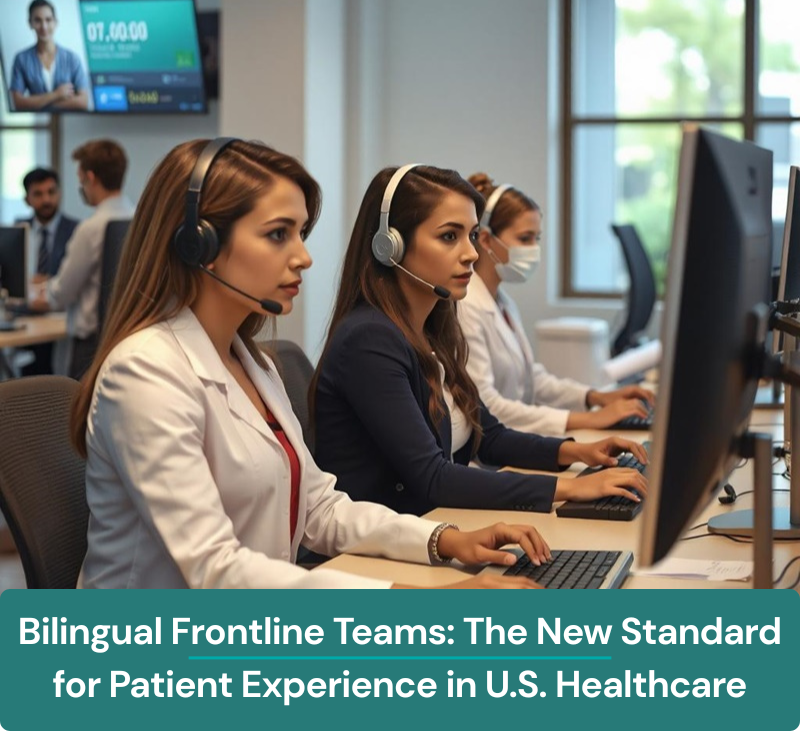
In an era of high patient call volumes, especially around benefits, billing, and care navigation, bilingual call center agents play a critical role. Their ability to engage with cultural fluency reduces average handle time, increases first-call resolution, and prevents costly misunderstandings. For healthcare organizations, this translates into improved operational efficiency and higher patient satisfaction scores. - Bilingual medical support staff
From clinics and pharmacies to specialty practices, bilingual staff bridge communication gaps that often derail care. Whether clarifying prescription instructions, assisting with referrals, or supporting chronic disease management programs, they strengthen adherence and reduce errors. Their presence not only improves patient safety but also builds lasting loyalty among multicultural patient populations.
Together, these roles illustrate how bilingual capacity permeates every layer of healthcare delivery—not as a “nice-to-have,” but as an essential component of patient-centered operations and sustainable growth.
From Compliance to Competitive Advantage
The traditional approach to language access—outsourced interpretation or ad hoc translation—has proven insufficient. These solutions are reactive, fragmented, and often fail to support the 4 P’s of patient experience:
- Proactive: Anticipating patient needs before issues escalate
- Personalized: Aligning with patient preferences and culture
- Predictive: Identifying risk factors using real-time communication insights
- Precise: Ensuring accuracy in treatment instructions and care coordination
Bilingual frontline healthcare staff transform language access from a regulatory obligation into a market differentiator. When patients feel understood, they are more likely to trust providers, adhere to care plans, and recommend services.
Workforce Pressures Demand Innovation
Beyond patient-facing impact, workforce realities cannot be ignored. The U.S. healthcare system is already facing a shortage of more than 500,000 nurses, along with significant gaps in entry-level healthcare support roles. Recruiting, training, and retaining a multilingual workforce domestically has become both cost-prohibitive and operationally unsustainable. Healthcare leaders today must adopt new workforce models that balance scalability, quality, and cost predictability. Outsourcing in healthcare is no longer the same—it has evolved. At Helium, we call this evolution #NearShoreOps—operations designed closer to the U.S., aligned in time zone, culturally fluent, and healthcare-trained. This framework enables healthcare organizations to scale bilingual patient support seamlessly, without compromising quality or patient trust.
ROI of Bilingual Frontline Healthcare Teams
C-Suite and procurement leaders evaluate workforce strategies on measurable returns. Bilingual frontline teams deliver impact across cost, quality, and growth metrics:
- Improved patient retention: LEP patients served in their language show 25–30% higher adherence to care plans, directly reducing churn and increasing lifetime value.
- Reduced errors: Direct bilingual communication reduces medication and discharge errors linked to translation gaps.
- Operational savings: Bilingual patient support teams reduce call escalations and rework, driving down administrative costs.
- Revenue protection: Higher patient satisfaction scores safeguard reimbursements in value-based care models.
- Workforce sustainability: Access to a trained bilingual talent pool reduces turnover and recruitment strain in U.S. markets.
The Future of Patient Experience: Bilingual and Borderless
As healthcare organizations navigate workforce shortages, evolving patient demographics, and pressure to deliver measurable outcomes, one fact is clear: patient experience in U.S. healthcare cannot be optimized without bilingual capacity at the frontline.
Bilingual healthcare teams are no longer optional—they are the new standard of care delivery. And with #NearShoreOps, providers have a scalable, sustainable model to integrate these capabilities with a model designed for both today’s realities and tomorrow’s growth.
Conclusion
This era of patient experience in U.S. healthcare is being defined not only by medical innovation but by communication, empathy, and cultural competence. Clinical breakthroughs and new technologies will continue to shape care delivery, but without the ability to connect with patients in their own language and cultural context, progress remains incomplete.
Bilingual frontline teams bring these critical elements into the core of patient care. They enable providers to meet regulatory obligations, reduce disparities, and prevent costly errors—while building the trust that drives patient satisfaction and long-term loyalty. For millions of patients, having access to bilingual care is not simply a convenience; it is the foundation of safety, dignity, and confidence in the healthcare system.
For executives, the conversation is no longer about if bilingual healthcare teams are necessary—it is about how fast they can be integrated into patient care strategies. Those who move quickly will not only elevate patient experience but also strengthen market position, reduce workforce strain, and capture new growth opportunities.
At Helium, we call this model #NearShoreOps—operations designed closer to the U.S., aligned in time zone, culturally fluent, and healthcare-trained. Organizations that adopt this framework will be best positioned to deliver patient-centered, accessible care while achieving measurable returns in performance, scalability, and innovation.
Published on September 18, 2025
Written by Camilo Sánchez