
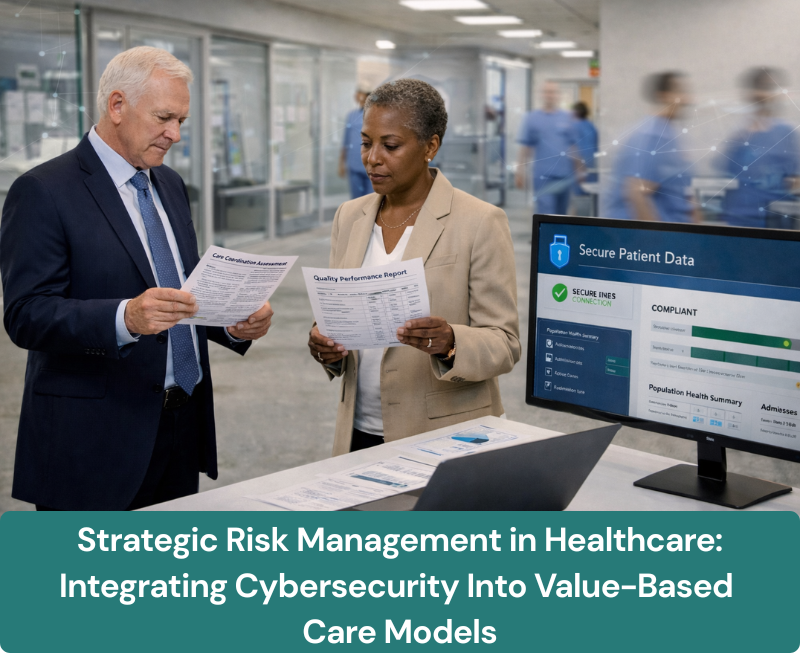
Healthcare leaders no longer have the luxury of treating cybersecurity as a technical back-office function. In value-driven environments, it is a determinant of reimbursement, operational continuity, and patient trust.
Strategic risk management in healthcare now requires integrating cybersecurity directly into clinical, financial, and operational strategy. For C-suite executives, procurement leaders, and board members, the question is not whether to invest in cybersecurity, but how to align it with value-based performance, ROI, and long-term resilience.
This article explores how to operationalize a healthcare risk management strategy that embeds cybersecurity into value-based care models, strengthens enterprise governance, and enables scalable innovation through a disciplined operational framework.
Why Cybersecurity Is Foundational to Value-Based Care
Value-based care depends on secure, high-volume data exchange across providers, payers, and technology partners. Care coordination, risk scoring, quality reporting, and shared savings all rely on real-time access to accurate electronic protected health information (ePHI).
When that data pipeline is disrupted, performance suffers immediately.
Ransomware attacks freeze claims processing. Vendor breaches delay payer settlements. Compromised data corrupts quality metrics tied to reimbursement.
The average healthcare data breach cost impact is approximately $11.1 million per incident, including forensic investigations, legal exposure, regulatory penalties, ransom payments, and remediation. Operational downtime alone averages $1.3 million, not including productivity losses or revenue delays. Cyber insurance premiums frequently increase by 30–50% following major events.
For organizations operating under shared-savings contracts or risk corridors, these disruptions directly threaten:
- Outcomes-based reimbursement
- Quality score performance
- Chronic care management tracking
- Readmission penalties
- Population health analytics
In a value-based environment, cybersecurity is not merely compliance, it is revenue protection.
This is why cybersecurity in value-based care must be treated as a core strategic layer, not an add-on.
Compliance Is a Baseline. Risk Management Is Strategy.
Many healthcare organizations still approach cybersecurity through a compliance lens, focusing primarily on regulatory standards such as Health Insurance Portability and Accountability Act (HIPAA).
Compliance ensures minimum requirements are met.
However, healthcare cybersecurity risk management requires moving beyond checklists toward a risk-based approach to healthcare cybersecurity that quantifies threats, prioritizes mitigation by impact, and aligns controls with enterprise objectives.
The difference is material:
|
Compliance Focus |
Strategic Risk Management Focus |
|
Meeting regulatory standards |
Protecting revenue, operations, and patient safety |
|
Periodic audits |
Continuous monitoring |
|
Static control checklists |
Dynamic risk quantification |
|
IT ownership |
Enterprise governance |
Strategic integration requires adopting enterprise-wide frameworks such as ISO 31000 and aligning cybersecurity controls to NIST Cybersecurity Framework or ISO/IEC 27001. These frameworks provide structure for enterprise risk management in healthcare, ensuring cyber threats are evaluated alongside clinical, operational, and financial risks.
Enterprise Risk Management in Healthcare: A Unified Model
Effective value-based care risk management requires unifying risk domains under one governance structure.
An enterprise risk management (ERM) model integrates:
- Clinical safety risk
- Operational risk in healthcare organizations
- Financial exposure
- Cyber risk governance in healthcare
- Vendor and supply chain risk
- Regulatory and payer-driven risk requirements
Under this approach, cyber threats are not siloed within IT. They are escalated to board-level oversight with defined risk appetite statements and measurable tolerance thresholds.
A mature governance structure typically includes:
- Board-approved cyber risk appetite statements
- Privacy and security councils with formal charters
- Data governance committees
- Vendor risk rating systems
- Defined decision rights and escalation paths
By formalizing governance, organizations move from reactive incident response to proactive resilience.
Integrating Cybersecurity Into Healthcare Operations
Integrating cybersecurity into healthcare operations requires embedding security controls directly into clinical and administrative workflows.
Key operational components include:
1. Zero Trust and Identity-First Access
Zero Trust architectures assume no device, user, or application is trusted by default. Access is continuously validated based on identity, device posture, and context.
For value-based networks spanning hospitals, clinics, telehealth platforms, and home monitoring tools, Zero Trust reduces the attack surface while enabling secure interoperability.
2. Secure Data Exchange Across Networks
Value-based care relies on accountable care organizations (ACOs), clinically integrated networks (CINs), and payer data exchanges.
Encryption at rest and in transit, endpoint protection, and real-time monitoring protect PHI while allowing seamless coordination across distributed care ecosystems.
3. Vendor Risk Management
Third-party attacks have become one of the largest systemic risks in healthcare. Incidents affecting claims processors and clearinghouses have demonstrated how vendor vulnerabilities cascade across provider networks.
A strong healthcare IT risk strategy includes:
- Vendor penetration testing requirements
- Cyber resilience attestations
- Contractual data protection clauses
- Ongoing third-party risk scoring
Procurement leaders play a critical role here. Vendor selection is now a cyber governance decision, not just a cost negotiation.
Cyber Threats and Reimbursement Risk
Cyber incidents do more than create IT disruptions, they destabilize value-based reimbursement.
Consider the operational chain:
- A ransomware attack freezes billing systems.
- Claims submission halts.
- Quality metrics reporting is delayed.
- Payer negotiations stall.
- Cash flow tightens.
In shared-savings or downside-risk contracts, delayed outcomes tracking can invalidate performance benchmarks.
Disruptions also compromise:
- Chronic care documentation
- Readmission tracking
- Risk-adjustment coding accuracy
- Insurance verification
When quality metrics are incomplete or corrupted, organizations face penalties, reduced shared savings, or contract termination.
Aligning cybersecurity with value-based reimbursement protects both revenue integrity and contractual performance.
First Steps in a Strategic Healthcare Risk Management Strategy
For executives asking where to begin, the following phased approach is practical and measurable:
Phase 1: Baseline Risk Visibility
- Conduct penetration testing on internet-facing applications, patient portals, and connected medical devices.
- Implement real-time asset discovery to identify shadow IT.
- Map data flows across clinical and administrative systems.
Phase 2: Risk Prioritization
- Rank vulnerabilities by criticality and business impact.
- Quantify potential financial exposure.
- Define mean time to risk resolution (MTTR) targets.
Phase 3: Governance Formalization
- Establish board-level cyber reporting.
- Approve risk appetite thresholds.
- Align policies to recognized frameworks (NIST, ISO).
Phase 4: Resilience Planning
- Develop incident response playbooks.
- Conduct tabletop exercises.
- Integrate cyber scenarios into business continuity plans.
This structured approach moves organizations toward healthcare cyber resilience, prioritizing continuity and recovery, not just prevention.
Measuring Cyber Risk Exposure: Executive KPIs
For C-suite leaders, cybersecurity must be measurable in operational and financial terms.
Key KPIs include:
- Breach frequency and severity
- ePHI exposure incidents
- Critical unresolved vulnerabilities
- Mean time to detect (MTTD)
- Mean time to respond (MTTR)
- Compliance audit scores
- Vendor risk ratings
- Operational downtime impact
- Patient safety indicators tied to system availability
When tied to reimbursement and quality metrics, these indicators transform cybersecurity from a cost center into a performance driver.
Operational Resilience: The Competitive Advantage
Traditional cybersecurity emphasized perimeter defense. Modern healthcare demands resilience.
Resilience ensures:
- Rapid restoration of billing systems
- Continuity of care coordination tools
- Preservation of quality reporting
- Maintenance of patient communication channels
In value-based contracts, even brief disruptions can erode margin. Organizations with tested resilience plans maintain stability while competitors absorb revenue shocks.
Operational resilience becomes a differentiator in payer negotiations.
Extending the Model: #NearShoreOps as a Strategic Enabler
Cybersecurity integration and risk governance alone are not sufficient. Execution capacity matters.
Healthcare organizations must operationalize these frameworks across revenue cycle management, patient access, data governance, and care coordination workflows.
This is where the concept of #NearShoreOps emerges, not as a buzzword, but as an operational framework.
#NearShoreOps represents:
- Nearshore healthcare operations teams
- Bilingual, healthcare-trained professionals
- Alignment with U.S. time zones
- Cultural fluency with U.S. healthcare systems
- Integrated cybersecurity protocols
In value-based environments, patient access teams, eligibility verification specialists, quality data abstractors, and care coordination support must operate securely and seamlessly.
When structured under a governed model, #NearShoreOps enables:
- Secure data handling aligned with HIPAA cybersecurity strategy
- Real-time collaboration across provider networks
- Reduced operational costs without sacrificing quality
- Scalable support for population health initiatives
Because teams operate in similar time zones, escalation cycles shorten. Issue resolution accelerates. Quality reporting timelines improve.
For organizations balancing cost containment with risk exposure, #NearShoreOps provides a disciplined approach to expanding operational capacity while maintaining strict cybersecurity and compliance standards.
It strengthens:
- Patient experience continuity
- Care coordination responsiveness
- Financial performance under risk-based contracts
When embedded within a broader enterprise risk management in healthcare model, it becomes an extension of resilience strategy, not merely outsourcing.
Aligning Cyber Risk Governance With Growth Strategy
Healthcare leaders must align cyber risk governance with growth initiatives such as:
- Telehealth expansion
- Remote patient monitoring
- AI-enabled care coordination
- Cloud-based EHR integration
Each innovation increases data flow complexity and attack surface.
A mature healthcare risk management strategy evaluates cyber exposure before scaling digital initiatives, ensuring innovation does not outpace governance.
Boards should require:
- Risk-adjusted ROI projections
- Cyber impact assessments for new vendors
- Integrated financial and operational risk dashboards
Growth without cyber governance is volatility.
Growth with integrated cybersecurity becomes sustainable performance.
The Financial Case for Strategic Integration
Executives frequently ask about ROI.
The return on integrated cybersecurity appears in:
- Avoided breach costs (~$11.1M per incident)
- Reduced downtime losses (~$1.3M average)
- Lower insurance premium volatility
- Preserved shared savings revenue
- Strengthened payer contract negotiations
- Increased patient trust and retention
Moreover, organizations demonstrating mature cyber risk governance in healthcare often experience:
- Faster vendor approvals
- Higher partner confidence
- Reduced regulatory scrutiny
- Greater strategic agility
In value-based ecosystems, trust is currency. Cyber resilience protects that currency.
Conclusion: Cybersecurity as Strategic Infrastructure
Strategic risk management in healthcare demands a shift in mindset.
Cybersecurity must be viewed as:
- Clinical infrastructure
- Financial safeguard
- Governance priority
- Operational enabler
- Patient trust mechanism
In value-based care models, protecting patient data is inseparable from protecting reimbursement.
By integrating cybersecurity into enterprise risk management, aligning governance with operational workflows, measuring exposure with executive KPIs, and extending capacity through disciplined frameworks like #NearShoreOps, healthcare organizations can scale innovation without compromising quality or financial stability.
The leaders who succeed in the next phase of healthcare transformation will not treat cybersecurity as an IT expense.
They will treat it as strategic infrastructure, embedded, measurable, and aligned with value creation.
Published on March 02, 2026