
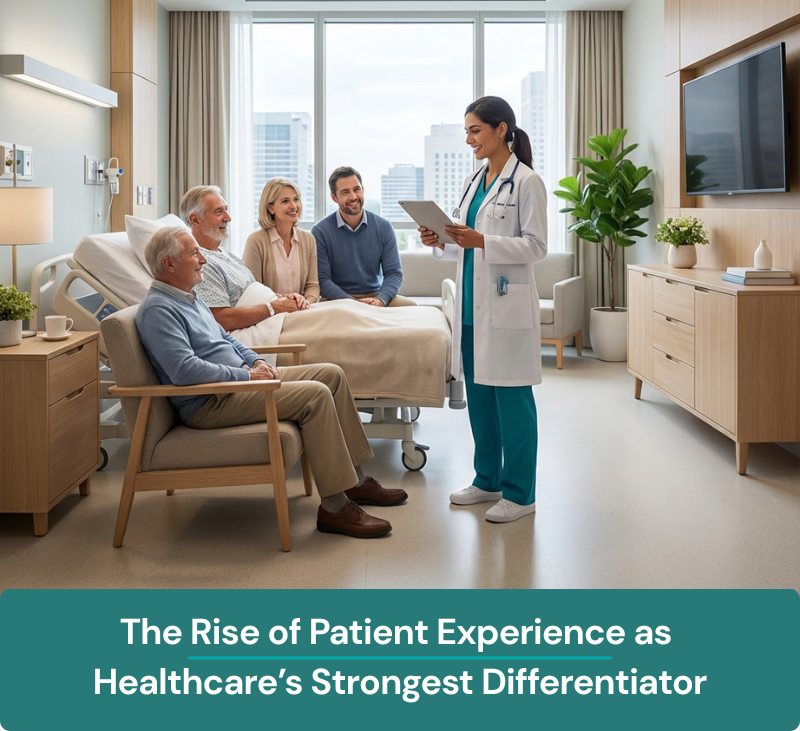
For more than a decade, healthcare organizations have invested heavily in digital transformation, new clinical models, and cost-containment strategies. Yet in 2025, one factor has emerged as the single most reliable differentiator for providers competing in a crowded, increasingly consumer-driven market: patient experience in healthcare.
Patient experience has evolved from a patient satisfaction measure into a performance, revenue, and brand-defining indicator. Today, it influences everything from reimbursement and payer relationships to workforce stability, clinical adherence, and operating margins. And while clinical excellence remains critical, health systems with strong and consistent patient experience capabilities are outperforming peers on growth, retention, and visibility, regardless of size or market.
This shift is not theoretical. It is operational, measurable, and already changing how forward-thinking executives make strategic decisions.
Why Patient Experience Became Healthcare’s Strongest Differentiator
Healthcare has always been complex, but today’s consumers face even more friction: longer wait times, staffing shortages, rising costs, inconsistent communication, and opaque processes. These pain points shape the entire care journey, not just the clinical encounter.
Research consistently shows that the experience patients have before, during, and after the appointment, drives outcomes and loyalty:
- Experience predicts clinical results. Patients who report positive experiences show higher treatment adherence and up to 30% lower readmission rates.
- Experience predicts financial performance. Organizations with top-quartile patient experience scores can see 2–4% revenue lift from retention, referrals, and payer performance.
- Experience shapes market reputation. Nearly 60% of patients today choose or switch providers based on communication quality, empathy, and ease of access.
In a market where the services themselves can look similar, patient experience is what differentiates healthcare organizations.
The drivers behind this shift include:
- Rising healthcare consumer expectations.
Patients expect clarity, convenience, and seamless service, mirroring retail, banking, and travel industries. - Workforce shortages impacting service quality.
Burnout and staffing gaps directly affect communication, empathy, and operational responsiveness. - Increasing cost pressures for patients and payers.
When healthcare becomes more expensive, consumers expect more value from every interaction. - The surge of digital-first engagement.
From online scheduling to AI-powered communication, patients judge organizations on their digital maturity. - Market transparency.
Ratings, reviews, and publicly reported scores now influence perception and payer negotiations.
The message is clear: patient-centered healthcare is not just clinically responsible, it is strategically essential.
What Patients Value Most And What Breaks the Experience
Across multiple studies, five factors consistently shape the modern healthcare experience:
Staff Attitude and Communication Quality: This remains the strongest predictor of patient satisfaction. Patients value empathy, clarity, and personalized communication. When communication fails, trust erodes especially when costs and complexity are high.
Convenience and Service Accessibility: This includes appointment availability, scheduling ease, wait times, and navigation. Long waits and inefficient processes are some of the top drivers of negative patient experience.
Facility Environment and Technology: Patients increasingly expect modern, intuitive, digitally supported environments. Navigation tools, digital check-in, wayfinding, and mobile updates improve perceived quality.
Personalized Care and Respect: Patients want to feel seen, not processed. Personalized interactions are consistently linked with higher satisfaction and loyalty.
Financial Clarity: Confusing billing, surprise charges, or reimbursement issues directly undermine patient confidence, even when clinical care is excellent.
When organizations fall short due to bottlenecks, poor communication, staff burnout, or administrative backlog, the patient experience deteriorates. These issues often originate in operational inefficiencies, not clinical limitations.
The Strategic Imperative: Patient Experience as an ROI Engine
For C-suite executives, patient experience must be viewed through the lens of operational excellence, financial performance, and brand competitiveness. It is not a soft metric; it is a business driver.
Experience reduces cost of care
Patients with positive experiences follow care plans, reducing complications and avoidable hospital use.
Experience boosts revenue
Higher satisfaction scores correlate with:
-
Increased patient loyalty
-
Higher lifetime value
-
Better payer relationships and quality incentives
Experience supports workforce retention
Teams working in efficient, well-supported environments deliver better care and experience lower burnout.
Experience accelerates digital transformation ROI
Technologies such as AI scheduling, digital navigation, and patient engagement platforms only deliver real value when paired with well-designed operational workflows.
Experience strengthens competitive differentiation
In saturated markets, patient loyalty has become the single strongest growth engine. Reputation travels fast, and organizations with consistent, well-structured patient experience outperform on acquisition and retention.
Operational Factors That Make or Break Patient Experience
Executives understand that clinical excellence cannot exist in isolation. The patient journey includes dozens of operational touchpoints, most of which happen before the patient even sees a provider.
When any of these fail, experience declines:
Administrative friction: Slow scheduling, confusing communication, and lack of follow-up cause frustration and delays.
Wait time variability: Long wait times remain one of the biggest negative drivers of patient perception and loyalty.
Inconsistent or unclear communication: Patients want proactive, clear, and timely updates, not fragmented messages across channels.
Staffing shortages: These affect everything from wait times and responsiveness to empathy and service attitude.
Technology gaps: Patients expect digital-first service; lack of modern tools or disjointed systems disrupt the experience.
Financial complexity: Surprise billing or unclear pricing causes dissatisfaction even when clinical care is strong.
Addressing these challenges requires more than internal process improvement. It requires a rethink of operational models.
Strategies Healthcare Organizations Use to Improve Patient Experience
Hospitals and health systems accelerating patient experience improvements share a consistent pattern: they treat experience as a cross-functional operational strategy not as a marketing or satisfaction initiative.
Leading strategies include:
Digital-first engagement: From mobile pre-registration to AI-enabled reminders and chatbots, digital touchpoints reduce friction and give patients control.
Real-time feedback loops: Kiosks, SMS surveys, and mobile apps allow immediate issue detection and service recovery.
Navigation and convenience tools: Indoor navigation, automated check-in, and appointment management reduce confusion and wait-time dissatisfaction.
Staff training and communication excellence: Empathy, clarity, and personalization remain core to patient perception.
Coordinated care pathways: Cross-functional updates, clinical and administrative, create seamless journeys.
Operational support models that scale: Organizations are increasingly turning to specialized operational partners to support scheduling, communication, follow-ups, and patient engagement workloads.
This last trend is reshaping the industry and it’s where #NearShoreOps enters the conversation.
Introducing #NearShoreOps: The New Framework for Operational Excellence in Patient Experience
Healthcare leaders know that improving patient experience requires consistent, high-quality operational execution. But U.S. healthcare organizations face a resource gap:
- Short staffing
- Rising labor costs
- High burnout
- Increasing administrative complexity
Traditional outsourcing models, especially offshore, struggle to meet the level of nuance, cultural alignment, bilingual fluency, and real-time responsiveness that patient experience requires.
This is where #NearShoreOps emerges, not as a buzzword, but as a strategic operational framework built specifically for modern healthcare performance.
What is #NearShoreOps?
#NearShoreOps is a model that integrates nearshore location proximity, with Latin America operating in alignment with U.S. time zones, bilingual talent trained specifically for healthcare, and teams equipped with specialized administrative and patient engagement skills. It also incorporates cultural alignment with U.S. healthcare consumers and offers operational scalability without compromising quality. Unlike offshore solutions, #NearShoreOps teams collaborate in real time, communicate with cultural fluency, and operate naturally within the workflow rhythm of U.S. healthcare organizations. This makes the model ideal for strengthening patient scheduling, coordination, communication workflows, billing support, and engagement initiatives, all of which are essential drivers of patient experience.
Why #NearShoreOps matters for patient experience
Because patient experience depends on:
- Fast response times
- Clear communication
- Accurate scheduling and follow-up
- Empathetic interactions
- Reduced wait times
- Smooth navigation
And these are operational functions that require teams who are skilled, consistent, and deeply integrated with U.S. care processes.
#NearShoreOps allows health systems to scale those capabilities without straining internal teams, improving both experience and operational performance simultaneously.
Real-World Applications: How Operations Drive Better Patient Experience
Here is where the operational advantage becomes clear.
#NearShoreOps models strengthen patient experience by supporting core administrative and engagement functions:
Scheduling & Access Optimization
Scheduling is one of the highest-impact levers of patient experience. Poor access leads to lost revenue, poor outcomes, and lower satisfaction.
With #NearShoreOps support:
-
Call response times improve
-
Backlog decreases
-
No-show reduction programs operate more consistently
-
Patients receive proactive reminders and follow-ups
Health systems report measurable impact: more appointments completed, reduced wait times, higher engagement.
Digital Patient Engagement
#NearShoreOps teams support digital channels such as:
-
SMS campaigns
-
Portal navigation assistance
-
AI-assisted communication
-
Follow-up instructions
-
Care coordination messaging
This creates a consistent patient journey, improved clarity, and better treatment adherence.
Care Coordination and Provider Communication
Patients often struggle with fragmented care journeys. Nearshore operational teams help standardize:
-
Post-visit follow-up
-
Specialist referrals
-
Test-result explanations
-
Pre-authorizations and eligibility checks
These touchpoints significantly influence patient trust and satisfaction.
Financial Communication & Transparency
Billing confusion is one of the biggest negative drivers of patient satisfaction.
#NearShoreOps teams improve experience by:
-
Explaining benefits
-
Clarifying invoices
-
Helping with payment plans
-
Guiding patients through insurance processes
This reduces anxiety and increases confidence in the organization.
Operational Load Reduction for Clinical Staff
When physicians, nurses, and front-desk staff are freed from administrative burdens, they have more time for empathetic, patient-centered communication—the strongest predictor of positive experience.
#NearShoreOps directly supports this by absorbing high-volume administrative tasks.
The Business Case: How Patient Experience Drives Organizational Performance
C-suite leaders want measurable ROI, not anecdotes. The data is increasingly clear:
Higher patient loyalty & lifetime value
Positive experience increases loyalty by 20–30%, leading to more referrals and repeat visits.
Lower cost of care
Better experience correlates with better adherence, reducing complications and avoidable utilization.
Higher workforce satisfaction
Reducing frontline administrative load reduces turnover often one of the largest hidden cost centers.
Stronger payer relationships
Experience scores tie directly to quality incentives and contract performance.
Better brand differentiation
In markets where services look similar, experience becomes a primary competitive signal.
Operational efficiency
#NearShoreOps drives efficiency gains through consistent workflows and scalable administrative execution.
The result is a model where improving patient experience directly strengthens financial and operational outcomes.
The Future: Patient Experience as the Core of Healthcare Strategy
Looking ahead to 2025 and beyond, patient experience will define organizational strategy. Industry trends show:
- Whole-person care models requiring more coordinated communication
- Generative AI enabling personalized engagement but requiring operational integration
- Behavioral health expansion relying heavily on empathetic, timely communication
- Condition-specific care models needing precise navigation support
- Sustainability and ethical care expectations influencing consumer choices
These trends reinforce one conclusion:
Patient experience is not an initiative, it is the operating system of modern healthcare.
And the organizations that lead in this domain will be those that align their operational infrastructure to support clarity, speed, empathy, and convenience at scale.
#NearShoreOps is emerging as the most effective and sustainable operational model to make that possible.
Building a Healthcare System Where Experience Drives Excellence
Healthcare has reached a turning point: margins are tighter, consumer expectations are higher, and competition is increasing. In this environment, patient experience has become the most powerful lever for growth, differentiation, and financial resilience.
But exceptional patient experience does not happen by chance, it is the result of operational excellence, supported by scalable teams, streamlined workflows, and a culture of patient-centered care.
Organizations adopting #NearShoreOps are demonstrating that high-quality, real-time operational support can significantly improve scheduling, communication, navigation, follow-up, and financial clarity, the core drivers of patient satisfaction and loyalty.
Patient experience is now the strategic differentiator that defines winners in the healthcare market. And the organizations that invest in modern, scalable operational models will lead the next era of patient-centered healthcare.
Published on November 25, 2025