
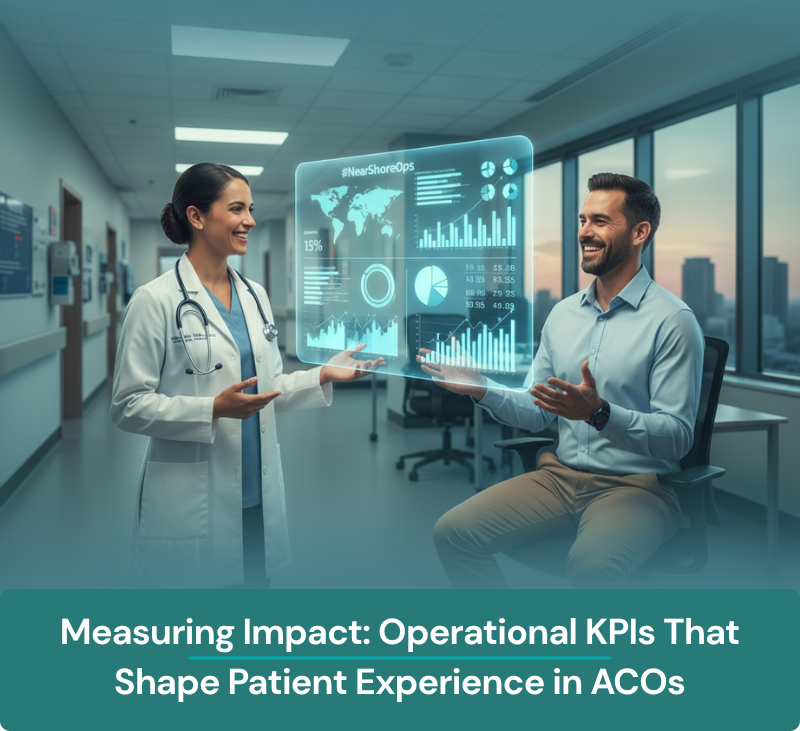
Healthcare is shifting from volume to value. Across the U.S., Accountable Care Organizations (ACOs) are under increasing pressure to deliver measurable outcomes, not just more procedures or visits, but better experiences, healthier populations, and sustainable cost control. In this environment, operational performance has become inseparable from clinical quality.
The question is no longer whether to measure, but what truly matters when measuring healthcare operations. Operational KPIs are the compass that guides this transformation, aligning resources, optimizing care coordination, and directly influencing how patients perceive their journey through the healthcare system.
However, the complexity of modern healthcare operations makes this a delicate balance. Tracking the wrong metrics can create noise and inefficiency. Focusing on the right ones, by contrast, drives strategic clarity and continuous improvement.
This is where innovative operational models such as #NearShoreOps come into play, a nearshore framework that connects healthcare-trained, bilingual teams in aligned time zones with U.S.-based organizations. Beyond being a workforce solution, #NearShoreOps represents an operational philosophy that translates KPIs into action, enabling scale, agility, and patient-centered results.
The Strategic Role of Operational KPIs in Healthcare
Operational KPIs in healthcare are measurable indicators that assess how efficiently and effectively a healthcare organization delivers services. They encompass everything from patient throughput and staff productivity to billing accuracy and care coordination efficiency.
For ACOs and value-based organizations, operational KPIs serve as the bridge between strategic goals and day-to-day activities. When properly defined and monitored, they make invisible processes visible, helping leaders detect early warning signs, benchmark performance, and optimize outcomes across the continuum of care.
These metrics are essential not only for compliance or reporting but for decision-making. Data from sources like insightsoftware and Databox show that organizations using KPI-driven dashboards report 20–30% faster decision cycles and measurable gains in both patient satisfaction and financial performance.
In practice, operational KPIs support three key priorities:
- Efficiency: Reducing redundancies and bottlenecks across administrative and clinical workflows.
- Quality: Maintaining consistent standards in care delivery and service processes.
- Sustainability: Balancing financial health with patient outcomes for long-term viability.
The result is a more agile operation, one that anticipates patient needs, uses resources wisely, and reinforces the value-based care model.
How KPIs Influence the Patient Experience
Patient experience is the true north of healthcare performance. It reflects how patients perceive the care they receive, from their first appointment to post-discharge follow-up. Operational KPIs directly shape these perceptions because they influence the reliability, responsiveness, and empathy embedded in care delivery.
Key patient experience KPIs include:
- Customer Satisfaction Score (CSAT): Measures patient satisfaction with specific aspects of care such as communication, facility conditions, or staff responsiveness.
- Net Promoter Score (NPS): Gauges loyalty and likelihood to recommend the provider, a leading indicator of patient retention.
- Wait Time: Captures operational efficiency from the patient’s perspective, strongly correlated with satisfaction and trust.
- First-Contact Resolution: Tracks how often patient inquiries or issues are resolved without escalation.
Data from healthcare benchmarking studies indicate that reducing patient wait times by 20% can raise satisfaction scores by up to 15%. Similarly, ACOs that consistently achieve NPS scores above 60 tend to outperform peers in quality incentive programs.
What makes these KPIs powerful is their ability to connect operations with outcomes. Shorter response times, accurate billing, coordinated care transitions, and proactive communication, all are operational factors that define how patients feel about their care. In a value-based ecosystem, these experiences influence not only satisfaction but reimbursement, retention, and brand trust.
The ACO Lens: Measuring Performance Where It Matters
Accountable Care Organizations (ACOs) operate under a unique model of shared accountability. They bring together hospitals, physicians, and other providers to deliver coordinated care for Medicare beneficiaries. Their success depends on achieving quality and cost benchmarks, which makes KPI management mission-critical.
Key ACO performance indicators include:
- Readmission Rate: A primary measure of care quality and continuity.
- Preventable Hospitalization Rate: Reflects the effectiveness of primary and preventive care.
- Population Health Management Metrics: Monitor chronic disease outcomes, immunization rates, and patient engagement levels.
- Cost-to-Care Ratio: Measures operational efficiency relative to patient outcomes.
- Client Health Improvement Rate: Tracks clinical progress across defined populations.
The Centers for Medicare & Medicaid Services (CMS) uses these and other benchmarks to determine incentive payouts. ACOs that outperform peers can share in the savings generated by improved efficiency.
Yet, achieving these outcomes is complex. Many ACOs struggle with data fragmentation, interoperability challenges, and workforce limitations. Real-time tracking of KPIs requires unified systems and coordinated teams, a level of operational maturity that few organizations reach without specialized support.
That’s why the conversation about KPIs in ACOs must extend beyond analytics, into operational design, workforce integration, and continuous improvement.
Operational KPIs That Directly Shape Patient Experience
While clinical quality metrics measure outcomes, operational KPIs determine how those outcomes are achieved. They describe the patient journey in motion, every touchpoint, process, and delay that can enhance or erode trust.
Examples of operational efficiency metrics that shape experience include:
- Time-to-Resolution: The average time to resolve a patient’s issue or case.
- Bed Turnover Rate: Indicates patient flow and resource optimization.
- Staff Utilization Ratio: Ensures adequate coverage and prevents burnout.
- Care Coordination Cycle Time: Measures how efficiently patient data moves across departments or providers.
- First-Call Resolution Rate: Tracks operational responsiveness in contact centers or patient engagement teams.
Organizations that integrate these KPIs into their performance dashboards often see faster response times, reduced administrative friction, and higher satisfaction. A report by Databox found that healthcare providers monitoring operational KPIs quarterly achieved up to 25% improvement in patient engagement and significant reductions in administrative overhead.
These metrics don’t only improve the patient journey, they also drive ROI. Streamlined operations lower the cost per patient encounter, reduce rework, and enable more productive use of clinical resources. When ACOs align operational and clinical KPIs, they unlock compounding benefits: fewer readmissions, stronger loyalty, and more predictable financial performance.
The #NearShoreOps Framework: Scaling Operations Without Compromising Quality
Operational excellence in healthcare doesn’t happen in isolation. It depends on the people and systems that sustain daily performance. As healthcare organizations expand, many face the dual challenge of maintaining quality while scaling cost-effectively.
This is where #NearShoreOps, a nearshore operations framework, becomes a strategic differentiator. Unlike traditional outsourcing models that often operate offshore and across time zones, #NearShoreOps brings together bilingual, healthcare-trained teams located in geographically and culturally aligned regions, such as Latin America and the Caribbean.
In practice, #NearShoreOps enables ACOs and healthcare providers to:
- Support real-time KPI monitoring through operational alignment and data accessibility.
- Deliver bilingual patient communication, ensuring empathy and clarity in every interaction.
- Operate in synchronized time zones, eliminating delays in care coordination or administrative workflows.
- Achieve cost efficiencies of 20–40% compared to domestic operations, without compromising regulatory or quality standards.
By embedding #NearShoreOps within healthcare operations, organizations can scale their back-office, billing, data management, and patient engagement functions seamlessly. The result is an integrated, KPI-driven operation that enhances both efficiency and experience.
Helium Health’s approach to #NearShoreOps demonstrates how operational partnerships can evolve from transactional outsourcing to strategic co-creation. It’s not about replacing teams, it’s about extending them with professionals trained in healthcare systems, patient communication, and data integrity.
In this model, operational KPIs are not static reports; they become living indicators of how well an organization delivers on its patient promise.
From Metrics to Meaning: Building a KPI-Driven Culture
Metrics only create value when they inform action. For ACOs, this means embedding KPI measurement into every layer of the organization, from executive dashboards to front-line operations.
A KPI-driven culture in healthcare involves:
- Clarity: Defining a small set of KPIs that align with strategic goals and patient outcomes.
- Accessibility: Ensuring leaders and staff can easily interpret and act on data insights.
- Accountability: Linking performance metrics to continuous improvement, not punishment.
- Integration: Combining clinical, operational, and financial data for holistic visibility.
Organizations that achieve this integration report faster innovation cycles and more resilient performance. When teams understand how their daily work impacts metrics like patient satisfaction or readmission rates, they’re more likely to drive proactive change.
Building such a culture requires consistent communication, leadership commitment, and smart operational design, which again highlights the value of frameworks like #NearShoreOps that enable scalable, data-driven execution.
The Future of Healthcare Operations Is Measurable, Human, and Nearshore
As healthcare continues its transition toward value-based care, measurement is no longer a back-office function, it’s a leadership imperative. Every patient experience, every interaction, every operational step contributes to an ecosystem of outcomes that define an organization’s reputation, reimbursement, and resilience.
Operational KPIs give this complexity a structure. They quantify what matters: responsiveness, coordination, and reliability. For ACOs, they serve as both compass and catalyst, guiding providers toward consistent, high-quality, patient-centered care.
Yet metrics alone aren’t enough. The future of healthcare operations requires teams capable of interpreting data, acting on insights, and maintaining empathy throughout the process. That’s where #NearShoreOps transforms from a model into a mission.
By leveraging bilingual, healthcare-trained professionals across nearshore regions, ACOs can extend their operational reach while preserving cultural alignment and compliance standards. Nearshore teams bring the agility to adapt quickly to KPI findings, optimizing workflows, refining communication, and resolving issues in real time.
This approach offers measurable advantages:
- Reduced operational lag: Real-time response capabilities aligned with U.S. time zones.
- Improved patient satisfaction: Enhanced communication and empathy through bilingual engagement.
- Sustainable scalability: Cost efficiencies that support reinvestment into patient programs.
- Data integrity: Consistent KPI tracking and analytics that support informed decision-making.
Ultimately, operational KPIs are not about numbers, they are about narratives. Each metric tells a story: of a patient who waited less, understood more, and trusted deeper. When healthcare organizations integrate these insights through aligned teams and adaptive operations, they don’t just measure impact, they amplify it.
#NearShoreOps embodies this philosophy. It bridges the gap between measurement and experience, between efficiency and empathy. In doing so, it enables ACOs and healthcare leaders to build systems that are not only high-performing but also profoundly human.
That is the future of healthcare operations: measurable, intelligent, and nearshore.
Published on November 7, 2025
Written by Camilo Sánchez