
The U.S. healthcare system spends nearly $950 billion annually on administrative operations, representing roughly 25% of total healthcare spending. At the same time, healthcare organizations are facing severe workforce shortages, rising patient expectations, and growing operational complexity.
The result is a mounting operational crisis.
Clinicians now lose an average of 28 hours per week to administrative tasks, while 82% report experiencing burnout. Prior authorization delays alone generate an estimated $258 billion in annual waste, and the gap between operational demand and available healthcare talent continues to widen.
For healthcare leaders, the challenge is no longer simply reducing costs or adopting new technology. It is building operational models that can scale efficiently while preserving patient trust, empathy, and service quality.
That is why the conversation around AI in healthcare is shifting.
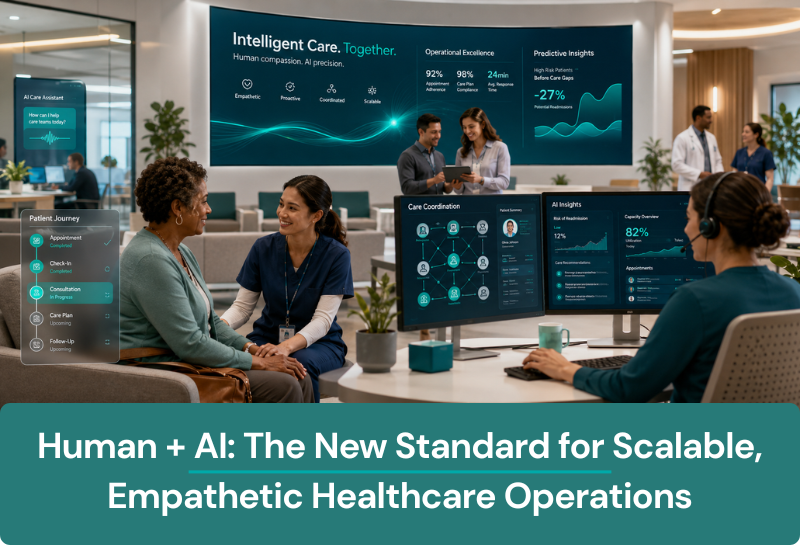
The organizations seeing the strongest results are not pursuing fully automated healthcare operations. They are building Human + AI operational models: hybrid systems where AI improves speed, workflow coordination, and administrative efficiency while trained human teams provide judgment, empathy, oversight, and patient-centered support.
This is rapidly becoming the new standard for scalable healthcare operations.
Why Human + AI Is Reshaping Healthcare Operations
Healthcare organizations are under pressure from every direction.
The U.S. is expected to face a shortage of approximately 139,000 physicians by 2033, while nearly 900,000 registered nurses are projected to leave the workforce by 2027. Meanwhile, the aging population continues to increase demand for care, creating operational strain that traditional staffing models alone cannot solve.
At the same time, healthcare systems are dealing with fragmented workflows, staffing shortages, reimbursement complexity, and rising consumer expectations for faster, more personalized experiences.
AI is emerging as a critical operational enabler because many healthcare workflows are highly repetitive, language-driven, and process-intensive.
According to Accenture, approximately 40% of healthcare working hours are language-based tasks, making them highly suitable for AI augmentation. These include:
- Appointment scheduling
- Eligibility verification
- Claims processing
- Prior authorizations
- Documentation
- Patient intake
- Follow-up communication
- Revenue cycle workflows
This is why healthcare organizations are aggressively exploring AI adoption. McKinsey reports that 91% of healthcare organizations now use AI in at least one operational function.
However, the most successful organizations are not replacing people with automation.
They are redesigning workflows around collaboration between humans and AI.
This distinction matters.
Only 17% of healthcare tasks can realistically be fully automated, while another 23% are best improved through AI augmentation. The future is not AI replacing healthcare operations teams. It is AI helping those teams operate faster, smarter, and more efficiently.
The Rise of Empathetic Automation in Healthcare
One of the biggest misconceptions about AI in healthcare is that automation reduces empathy.
In reality, healthcare organizations are discovering that thoughtfully designed AI workflows can actually improve patient experiences when paired with human oversight.
This is where the concept of empathetic healthcare operations becomes important.
Empathetic automation does not mean replacing human connection with chatbots. It means using AI to remove friction, delays, confusion, and repetitive administrative burdens that negatively affect both patients and healthcare staff.
For example, AI-assisted patient communication systems can:
- Detect patient anxiety through sentiment analysis
- Personalize appointment reminders
- Provide multilingual communication support
- Offer 24/7 scheduling assistance
- Reduce wait times and response delays
- Route sensitive cases to trained human teams
Patients increasingly support this model.
Recent surveys show:
- 79% of patients welcome AI-assisted virtual nursing support
- 70% support AI monitoring in hospitals
- 77% are willing to use AI-assisted healthcare tools
At the same time, patients clearly do not want fully autonomous healthcare experiences:
- 58% worry about lack of human oversight
- Nearly 8 in 10 patients worry about excessive dependence on AI
- 89% believe healthcare organizations should clearly disclose AI usage
The message from patients is clear:
AI is welcome when it improves convenience and responsiveness, but human oversight remains essential for trust.
That is why the future of patient-centered operational strategy is not automation alone. It is intelligent collaboration between AI systems and human teams.
Human-in-the-Loop AI for Better Patient Experiences
One of the most important frameworks emerging in healthcare operations is human-in-the-loop healthcare AI.
In this model, AI assists workflows, but humans remain responsible for oversight, escalation management, and high-stakes decisions.
This approach is becoming the operational standard because healthcare environments require:
- regulatory compliance,
- auditability,
- patient trust,
- contextual judgment,
- and safety validation.
AI performs best when handling:
- repetitive workflows,
- documentation,
- scheduling,
- data extraction,
- communication routing,
- and administrative coordination.
Humans perform best when handling:
- emotionally sensitive conversations,
- complex patient scenarios,
- ethical decisions,
- escalations,
- and nuanced clinical or operational judgment.
The strongest healthcare operational models combine both.
A national health plan demonstrated this successfully by deploying an AI-assisted medication preparation workflow that supported human teams during patient outreach. The result:
- Comprehensive Medication Review completion rates increased from 42% to 63% in one quarter
- Call times became shorter
- Patient satisfaction improved
- Patients reported feeling “heard again”
Notably, the AI was positioned internally as a “teammate,” not simply a tool.
That distinction reflects a broader industry shift:
AI is increasingly viewed as operational augmentation rather than workforce replacement.
Scaling Healthcare Operations Without Losing Empathy
Healthcare leaders are increasingly realizing that operational scalability cannot come at the expense of patient experience.
This is especially important in patient access, care coordination, scheduling, intake, and administrative support functions where communication quality directly affects trust and satisfaction.
This is where the Human + AI model becomes particularly powerful when combined with #NearShoreOps.
Nearshore healthcare operations provide healthcare organizations with:
- bilingual support capabilities,
- U.S. timezone alignment,
- cultural compatibility,
- operational flexibility,
- and scalable workforce capacity.
When integrated with AI-powered healthcare operations, nearshore teams become even more effective.
For example:
- AI can automate repetitive intake and verification tasks
- AI-assisted workflows can reduce manual documentation burden
- Intelligent routing can prioritize patient requests
- Human teams can focus on escalations and empathy-driven interactions
- Bilingual specialists can deliver culturally aligned patient communication
This creates a scalable support structure without sacrificing service quality.
Instead of relying solely on domestic staffing expansion, increasingly difficult in today’s labor market, healthcare organizations can build hybrid operational ecosystems where technology and human expertise work together seamlessly.
This model is especially relevant for:
- revenue cycle management,
- patient support operations,
- scheduling and intake,
- prior authorization workflows,
- care coordination,
- and healthcare back-office transformation.
The result is operational scalability with stronger continuity, responsiveness, and patient experience outcomes.
AI-Augmented Teams vs. Fully Automated Healthcare Support
There is growing consensus across healthcare that fully automated support models are insufficient for complex healthcare environments.
Healthcare interactions are fundamentally different from traditional customer service interactions. Patients are often vulnerable, stressed, anxious, or navigating complicated care journeys.
That requires operational empathy.
The most effective operational models today use AI to strengthen human teams rather than replace them.
|
Fully Automated Models |
Human + AI Healthcare Support Model |
|
Limited contextual understanding |
Human judgment for complex situations |
|
Risk of patient frustration |
Greater empathy and trust |
|
Compliance vulnerabilities |
Human oversight and auditability |
|
Rigid workflows |
Flexible escalation management |
|
Poor handling of edge cases |
Better patient-centered experiences |
|
Reduced personalization |
Personalized communication at scale |
This is why healthcare workflow automation with human oversight is becoming a preferred enterprise strategy.
Organizations adopting hybrid healthcare workforce models are seeing measurable operational benefits:
- Up to 30% reduction in no-shows
- Potential 30–60% reduction in cost-to-collect
- Reduced administrative burden
- Faster workflow completion
- Improved staff productivity
- Higher patient satisfaction
According to McKinsey, organizations with mature AI-enabled operational strategies are significantly more likely to achieve successful enterprise-scale AI outcomes and stronger revenue growth.
The operational advantage no longer comes from simply implementing AI.
It comes from integrating AI intelligently into workforce design.
The Future of Operational Efficiency in Healthcare
The future of healthcare operations will not be defined by isolated AI tools.
It will be defined by integrated, intelligent operational ecosystems.
Over the next several years, healthcare organizations are expected to move beyond basic automation into:
- multi-agent operational systems,
- AI-assisted workflow orchestration,
- predictive patient operations,
- intelligent care coordination,
- and domain-specific operational AI.
However, the organizations that succeed will not necessarily be those with the most advanced technology.
They will be the organizations that combine:
- operational discipline,
- scalable workforce strategy,
- governance frameworks,
- AI readiness,
- and patient-centered execution.
This is why the Human + AI model is becoming strategically important for healthcare executives, procurement leaders, and operational decision-makers.
Healthcare organizations need systems that are:
- scalable,
- compliant,
- financially sustainable,
- operationally resilient,
- and patient-centered.
AI alone cannot deliver that.
Human teams alone cannot scale efficiently enough to meet future demand.
But together, they create a new operational framework capable of supporting both growth and quality.
According to Deloitte, the greatest value from AI comes from “bringing the best of humans and machines together in concert.”
That principle is increasingly becoming the foundation of intelligent healthcare operations.
Human + AI Is Not a Trend; It’s the New Operating Model
Healthcare is entering a more disciplined phase of AI adoption.
The conversation is no longer about experimentation or hype. It is about operational execution.
Organizations are moving beyond the question of:
“Should we use AI?”
Instead, they are asking:
“How do we scale healthcare operations responsibly while protecting patient trust and workforce effectiveness?”
The answer increasingly points toward hybrid operational models built around:
- AI augmentation,
- human oversight,
- empathetic patient support,
- intelligent workflow automation,
- and scalable nearshore healthcare operations.
The healthcare organizations that succeed over the next decade will likely be those that understand a simple reality:
Efficiency without empathy does not scale sustainably in healthcare.
But Human + AI can.
Published on May 22, 2026