
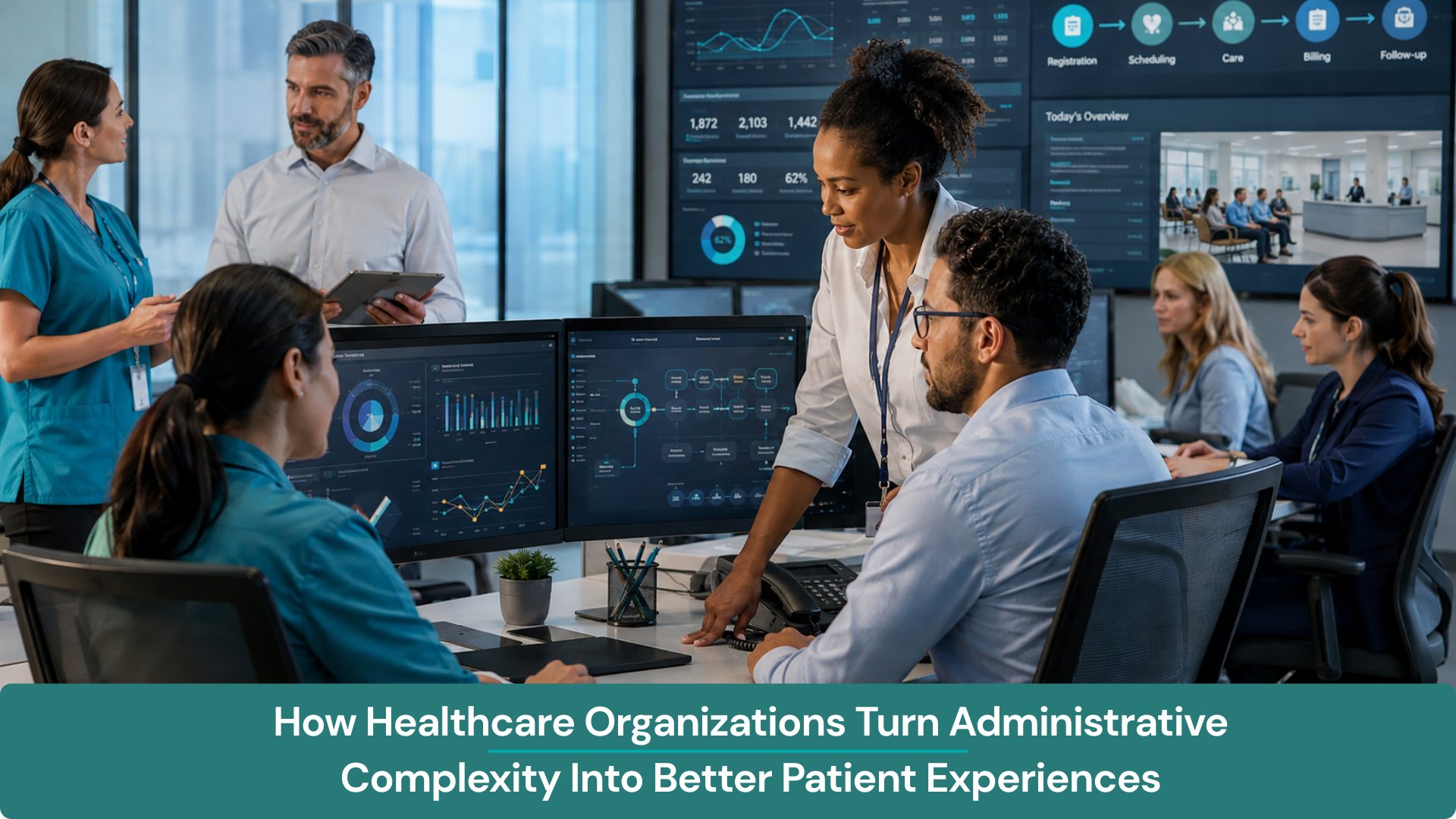
Clinical excellence has always been the foundation of quality healthcare. Yet for many patients, their perception of a healthcare organization is shaped long before they see a physician. It begins with scheduling an appointment, verifying insurance, completing registration forms, receiving timely updates, or resolving billing questions.
These administrative interactions have become some of the most influential drivers of patient experience in healthcare.
At the same time, administrative complexity in healthcare continues to increase. Expanding payer requirements, prior authorization rules, compliance obligations, workforce shortages, and fragmented technologies create operational friction that affects both providers and patients. While each process serves a purpose, together they often slow care delivery, increase staff workload, and raise operating costs.
The financial impact is substantial. Administrative spending in U.S. healthcare has been estimated at more than $800 billion annually, while one Commonwealth Fund-supported analysis found administrative complexity consumed nearly 12% of net patient service revenue in one healthcare organization. Physician practices also spend nearly $83,000 per physician every year interacting with payers, with nurses and medical assistants dedicating more than 20 hours per physician each week to insurance-related administrative tasks.
For healthcare executives, these figures highlight more than inefficiency. They reveal a significant opportunity to improve both operational performance and patient loyalty.
Leading organizations are discovering that meaningful healthcare process improvement often starts outside the exam room. By simplifying administrative processes, standardizing workflows, and reducing unnecessary friction, providers can create smoother patient journeys while improving financial performance.
This requires a different operating model. Instead of managing scheduling, eligibility, referrals, billing, and patient communication as separate functions, high-performing organizations treat them as one connected operational ecosystem.
That approach defines #NearShoreOps: a framework that combines healthcare-trained bilingual teams, standardized processes, intelligent automation, and nearshore operations aligned with U.S. time zones and cultural expectations. The objective is not simply to reduce costs, but to deliver more consistent, efficient, and patient-centered experiences at scale.
Administrative Complexity Has Become a Strategic Business Challenge
Administrative work is no longer confined to the back office. It directly influences patient access, clinician productivity, revenue cycle performance, and organizational reputation.
Research consistently identifies several areas as the primary sources of healthcare administrative complexity, including:
- Insurance verification
- Prior authorization
- Referral management
- Patient scheduling optimization
- Registration and intake
- Billing support
- Documentation and compliance
- Care coordination
These functions are essential, but they often involve multiple systems, manual handoffs, duplicate data entry, and varying payer requirements.
Patients experience the consequences immediately.
A delayed insurance verification may postpone treatment. Inefficient referral management can extend wait times. Poor communication leaves patients uncertain about next steps, while billing confusion often becomes the final impression they take away from an otherwise successful clinical visit.
Research from patient experience organizations consistently shows that appointment availability, scheduling reliability, billing transparency, and proactive communication are among the strongest drivers of patient satisfaction. Conversely, patients frequently delay or abandon care when administrative processes become difficult to navigate.
For healthcare leaders, administrative excellence is no longer an operational objective. It is a competitive advantage.
Patient Experience Begins Long Before Clinical Care
Patients rarely separate administrative service from clinical quality.
Every interaction contributes to their overall perception of the organization.
Even outstanding clinical outcomes can be overshadowed by long hold times, repeated paperwork, delayed referrals, or unclear billing communication.
This is why healthcare workflow optimization increasingly focuses on improving the administrative journey alongside clinical care.
The highest-impact patient touchpoints include:
- Appointment scheduling
- Pre-visit communication
- Insurance verification
- Digital registration
- Referral coordination
- Billing transparency
- Post-visit follow-up
When these processes work together, patients experience fewer delays, greater transparency, and more confidence throughout their care journey.
Operational metrics often reveal these improvements before patient satisfaction surveys do. Organizations pursuing healthcare operational excellence increasingly monitor indicators such as appointment lead time, referral completion rates, call abandonment, registration accuracy, prior authorization turnaround time, and first-pass insurance verification to identify friction before it affects patients.
Healthcare Workflow Optimization Starts With Simplification
Technology alone cannot solve administrative complexity.
One of the most common mistakes healthcare organizations make is automating inefficient processes instead of improving them first.
Successful organizations follow a different sequence.
First, they simplify workflows.
Next, they standardize processes.
Only then do they introduce automation.
This approach eliminates duplicate work, reduces unnecessary handoffs, clarifies ownership, and creates more consistent administrative experiences across the organization.
For example, rather than automating fragmented scheduling systems, leading providers first establish standardized scheduling rules. Instead of accelerating redundant documentation, they redesign intake processes to eliminate duplicate information requests.
Once these foundations are in place, automation becomes significantly more effective.
This philosophy also reflects Lean healthcare principles, where reducing waste and standardizing work create more reliable operations while making future technology investments more valuable. The result is greater operational efficiency in healthcare, fewer administrative errors, lower costs, and more time for staff to focus on patient-facing responsibilities.
Emerging Technologies Are Accelerating Administrative Transformation
Once organizations simplify their workflows, technology becomes a powerful enabler of healthcare operations optimization.
Today’s leading providers are moving beyond simple digitization toward orchestrated workflows that connect people, processes, and information more efficiently.
Several technologies are driving this shift.
Generative AI is supporting patient-facing assistants and staff copilots that answer routine questions, draft communications, and reduce hold times.
Healthcare workflow automation and healthcare process automation streamline repetitive activities such as insurance verification, prior authorization, referral management, appointment reminders, and billing workflows.
Intelligent Document Processing (IDP) accelerates the handling of referrals, medical records, insurance documents, and intake forms by extracting and routing information automatically instead of relying on manual data entry.
Predictive analytics is helping organizations forecast appointment demand, staffing needs, referral delays, and no-shows before they become operational bottlenecks.
Meanwhile, greater interoperability reduces duplicate information requests by enabling more seamless data exchange across providers, health plans, and care settings.
Industry experts increasingly agree that the objective is not simply deploying more technology, but removing friction from the patient journey. Technology creates the greatest value when it simplifies administrative work while allowing employees to focus on empathy, service recovery, and higher-value patient interactions.
#NearShoreOps: A Framework for Healthcare Operational Excellence
As healthcare organizations modernize administrative operations, many are recognizing that technology alone is not enough. Automation can eliminate repetitive work, but it cannot replace the judgment, empathy, and communication required to guide patients through complex healthcare journeys.
This is where #NearShoreOps provides a strategic advantage.
Rather than viewing nearshore healthcare outsourcing as a cost-saving initiative, leading providers are adopting it as an operational framework that combines specialized healthcare talent, standardized processes, and intelligent technology to improve both efficiency and patient experience.
The model brings together:
- Healthcare-trained bilingual professionals
- Standardized administrative workflows
- AI-enabled process automation
- Continuous quality monitoring
- U.S. time-zone alignment
- Cultural compatibility with American patients
This combination enables healthcare organizations to expand capacity without sacrificing consistency or quality.
It is particularly effective for high-volume administrative functions such as:
- Patient access optimization
- Patient scheduling optimization
- Insurance verification
- Referral management
- Prior authorization support
- Healthcare support services
- Revenue cycle support
- Patient communication
By allowing specialized teams to manage these operational workflows, healthcare organizations free internal clinical and administrative staff to focus on higher-value activities that directly impact patient care.
Research also shows that specialized operational partners provide greater workforce flexibility, stronger process discipline, and faster scalability during periods of growth or fluctuating demand.
Measuring Success Beyond Cost Reduction
Reducing expenses remains important, but today’s healthcare leaders evaluate healthcare administrative efficiency through a broader set of operational and patient-centered outcomes.
The most successful organizations monitor KPIs that reflect both operational performance and patient experience, including:
|
KPI |
Business Impact |
|
Appointment lead time |
Faster patient access |
|
Referral completion rate |
Better care coordination |
|
Prior authorization turnaround |
Shorter treatment delays |
|
Registration accuracy |
Less rework and fewer errors |
|
First-pass claim acceptance |
Improved revenue cycle performance |
|
Call abandonment rate |
Better patient communication |
|
Patient satisfaction scores |
Stronger loyalty and retention |
These metrics provide early visibility into operational friction while helping leaders prioritize continuous healthcare process improvement.
Administrative simplification also delivers measurable financial benefits by reducing labor-intensive work, minimizing claim rework, shortening revenue cycle timelines, and improving overall throughput. Research suggests these improvements could unlock hundreds of billions of dollars across the U.S. healthcare system while allowing organizations to redirect more resources toward patient care.
An Executive Roadmap for Administrative Excellence
Industry experts increasingly agree that administrative simplification should be treated as an enterprise-wide transformation rather than a collection of isolated projects.
Healthcare executives can accelerate progress by focusing on five priorities:
- Map the entire patient journey. Identify where patients experience delays, confusion, or unnecessary administrative steps.
- Standardize before automating. Simplify high-volume workflows before introducing new technology.
- Measure operational friction. Track KPIs such as appointment access, referral completion, authorization turnaround, and registration accuracy alongside patient satisfaction.
- Automate repetitive work. Use AI and workflow automation for rules-based tasks while allowing employees to focus on empathy, problem solving, and exception management.
- Build cross-functional governance. Align patient access, revenue cycle, IT, compliance, and patient experience teams around shared operational goals.
Organizations following these principles are better positioned to support value-based care operations, improve access, and create sustainable operational excellence.
Conclusion
Healthcare organizations will always operate within a complex administrative environment. The difference between average and high-performing organizations is not the amount of complexity they face, but how effectively they manage it.
Leaders who simplify administrative processes, standardize workflows, and strategically combine people with intelligent technology create experiences that feel seamless to patients while improving efficiency across the organization.
That is why administrative complexity in healthcare should no longer be viewed as a back-office challenge. It is a strategic opportunity to strengthen patient trust, improve workforce productivity, and support long-term financial performance.
The #NearShoreOps framework reflects this evolution by integrating nearshore healthcare-trained teams, bilingual expertise, workflow standardization, and intelligent automation into a scalable operating model. Rather than replacing internal teams, it extends organizational capabilities, enabling healthcare providers to improve access, reduce administrative burden, and deliver better patient experiences without compromising quality.
As healthcare continues shifting toward value-based care and consumer-driven expectations, organizations that make administrative interactions simpler, faster, and more connected will be the ones best positioned to lead.
Frequently Asked Questions
What is administrative complexity in healthcare?
Administrative complexity refers to the non-clinical processes required to deliver healthcare, including scheduling, insurance verification, prior authorization, referrals, billing, documentation, and patient communication. Inefficient workflows increase costs and create friction for both patients and providers.
How does healthcare workflow optimization improve patient experience?
By simplifying administrative processes, reducing delays, and improving communication, healthcare workflow optimization helps patients access care more easily while improving operational efficiency.
What technologies are improving healthcare administrative efficiency?
Organizations are increasingly using generative AI, workflow automation, intelligent document processing, predictive analytics, interoperable data exchange, and digital front door solutions to streamline administrative work and improve the patient journey.
Why are healthcare organizations adopting nearshore healthcare outsourcing?
Nearshore healthcare outsourcing provides access to bilingual, healthcare-trained professionals who support administrative operations in compatible U.S. time zones. This model improves scalability, operational consistency, and patient support while allowing internal teams to focus on higher-value clinical activities.
Published on August 3, 2026