
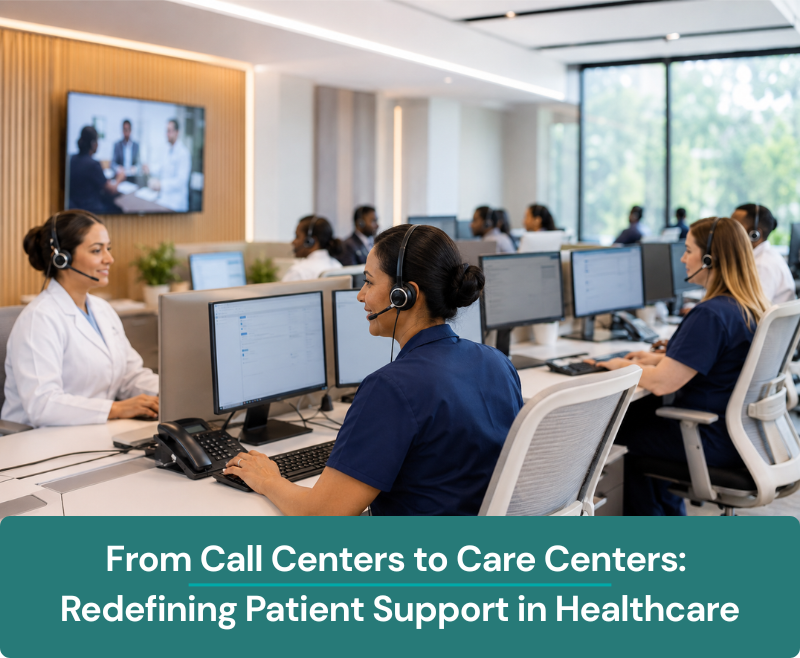
Healthcare leaders are investing billions in digital transformation, artificial intelligence, and patient engagement technologies. Yet many organizations continue to struggle with a fundamental challenge: patients still find healthcare difficult to navigate.
Long hold times, fragmented communication, scheduling delays, referral bottlenecks, and administrative complexity remain among the most common sources of patient frustration. At a time when patient expectations increasingly mirror consumer expectations in other industries, these inefficiencies create operational strain, weaken patient loyalty, and leave revenue on the table.
The issue is not simply technological.
Many healthcare organizations have modernized their systems without fundamentally rethinking how patient support is delivered.
That is why a growing number of health systems, physician groups, and specialty providers are moving beyond traditional call centers toward a care center model designed around access, coordination, and patient outcomes.
This shift reflects a broader reality: patient support is no longer an administrative function. It is a strategic capability that directly influences patient experience, operational performance, workforce productivity, and financial results.
Organizations that recognize this evolution are transforming patient support from a cost center into a competitive advantage.
Why Traditional Healthcare Call Centers Are No Longer Enough
Historically, healthcare call centers were measured by operational metrics such as average handle time, calls per hour, and occupancy rates. Agents focused on scheduling appointments, answering basic questions, and routing calls. Success was often defined by how quickly a call could be completed.
Today, that approach creates friction across the patient journey. Patients frequently encounter long hold times, multiple transfers, inconsistent information, and difficulty navigating referrals, insurance verification, or follow-up care.
These frustrations affect more than patient satisfaction scores. They can delay treatment, increase no-show rates, contribute to patient leakage, and create unnecessary administrative burdens across the organization.
Research consistently shows that access and communication are among the strongest drivers of patient satisfaction. In one outpatient study, patients who waited less than 15 minutes were nearly four times more likely to report high satisfaction compared to those experiencing longer wait times.
The lesson is simple: patient perception begins long before the provider enters the room.
As healthcare organizations continue to face workforce shortages and increasing demand, healthcare contact center transformation is becoming a strategic priority rather than an operational initiative.
The Hidden Cost of Poor Patient Access
Many healthcare organizations underestimate the financial impact of fragmented patient support.
When patients cannot easily schedule appointments, receive timely answers, or navigate the next step in their care journey, the consequences extend far beyond satisfaction scores.
Poor patient access can contribute to:
- Lost appointment revenue
- Higher no-show rates
- Increased patient leakage
- Lower provider utilization
- Administrative inefficiencies
- Greater staff burnout
- Reduced patient retention
For executives, this creates an important shift in perspective.
Patient support should not be viewed as a necessary administrative expense. It should be viewed as revenue protection infrastructure.
Every unanswered call, delayed response, abandoned referral, or scheduling bottleneck represents both an operational risk and a potential lost opportunity.
Leading healthcare organizations increasingly evaluate healthcare support operations not only through service metrics but also through their contribution to access, utilization, retention, and financial performance.
The Rise of the Care Center Model
A modern healthcare care center model serves as a centralized hub for patient access, communication, and care coordination.
Rather than simply answering calls, care center teams help patients navigate the healthcare system from their first interaction through ongoing engagement.
Typical services include:
- Appointment scheduling and optimization
- Referral management
- Insurance eligibility verification
- Prior authorization support
- Pre-registration assistance
- Patient education
- Follow-up outreach
- Care coordination and patient support
- Omnichannel communication management
The objective is to create patient support services in healthcare that reduce friction, improve communication, and ensure patients successfully move through their care journey.
This represents a significant shift in philosophy.
Healthcare leaders increasingly recognize that access is care.
When patients struggle to schedule appointments, understand instructions, complete referrals, or receive timely responses, the quality of care delivery is impacted long before clinical treatment begins.
Healthcare Call Center vs Care Center: Understanding the Difference
The distinction between a traditional healthcare call center and a modern care center is substantial.
Traditional call centers focus on transactions.
Care centers focus on outcomes.
Traditional environments prioritize metrics such as call volume and average handle time. Care centers prioritize first-call resolution, patient satisfaction, appointment access, referral completion, and continuity of communication.
Traditional support teams often operate with limited visibility into the broader patient journey.
Modern care centers integrate scheduling systems, electronic health records, referral workflows, and communication channels to create a more complete understanding of patient needs.
The result is a more coordinated, patient-centered healthcare support model capable of improving both operational performance and patient experience.
Patient Support Beyond Appointment Scheduling
One of the defining characteristics of modern healthcare support operations is the expansion of responsibilities beyond scheduling appointments.
Today’s patients require support navigating increasingly complex healthcare systems.
They need assistance with:
- Understanding insurance requirements
- Confirming coverage eligibility
- Coordinating referrals
- Completing registration requirements
- Receiving pre-visit instructions
- Managing follow-up appointments
- Accessing healthcare information
- Navigating multiple specialties
When these responsibilities are fragmented across departments, patients often encounter delays, duplicate requests, and inconsistent communication.
Centralized care centers help eliminate these challenges by creating a coordinated approach to patient journey support services.
For example, rather than simply booking an appointment, a care center representative may verify insurance eligibility, confirm referral requirements, coordinate specialty appointments, and provide pre-visit guidance.
This approach improves patient experience while reducing administrative burden for clinics and providers.
Why Patient Support Has Become a Business Imperative
The shift toward patient-centered healthcare support is often discussed through the lens of patient experience.
However, the business impact can be equally significant.
Improved Appointment Utilization
No-shows and scheduling gaps remain major challenges across healthcare organizations.
Care centers help improve appointment utilization through proactive outreach, reminder programs, waitlist management, and faster response times.
Even small reductions in no-show rates can create meaningful revenue gains across provider networks.
Reduced Administrative Costs
Centralized healthcare administrative support teams help eliminate duplicate work, standardize workflows, and improve efficiency.
When patients receive accurate information during their first interaction, organizations experience fewer repeat contacts and lower support costs.
Stronger Revenue Cycle Performance
Patient support functions directly influence revenue cycle outcomes.
Eligibility verification, prior authorization support, and pre-registration activities help reduce claim denials and improve reimbursement performance.
Organizations that strengthen front-end patient support often experience measurable downstream financial benefits.
Higher Patient Retention
Patients increasingly evaluate providers based on convenience, responsiveness, and communication quality.
Organizations that deliver exceptional healthcare patient engagement services create stronger loyalty and increase the likelihood of future utilization.
Better Workforce Utilization
Administrative responsibilities consume a significant amount of clinical and front-office staff time.
Centralized support models allow providers and care teams to focus on patient care while improving operational consistency.
The Human Side of Healthcare Support
Technology continues to reshape healthcare operations, but empathy remains one of the most important components of effective patient support.
Patients contacting a healthcare organization are often anxious, uncertain, or facing significant healthcare decisions.
A transactional interaction can increase frustration.
An empathetic interaction can build trust.
This is why successful care centers invest heavily in healthcare-specific training.
Support teams increasingly require expertise in:
- Healthcare terminology
- Insurance processes
- Prior authorization workflows
- Communication techniques
- Care coordination
- Privacy and compliance requirements
- Problem-solving and escalation management
An empathetic patient support model is not simply a customer service initiative.
It is an operational capability that strengthens patient relationships while supporting organizational goals.
Organizations embracing human-centered healthcare operations understand that empathy and efficiency are not competing priorities.
The strongest support programs deliver both.
Technology and Human Expertise: The New Standard
Healthcare leaders frequently ask whether automation will replace patient support teams.
The reality is more nuanced.
The future of healthcare support operations is not human or technology.
It is human plus technology.
Automation is highly effective for:
- Appointment reminders
- Scheduling confirmations
- Eligibility checks
- Basic inquiries
- Call routing
- Outreach campaigns
However, many interactions still require human judgment and emotional intelligence.
Examples include:
- Complex care coordination
- Multi-specialty scheduling
- Escalation management
- Insurance challenges
- Patient advocacy
- Sensitive healthcare conversations
By automating repetitive tasks, organizations enable healthcare-trained professionals to focus on higher-value interactions that improve patient experience and care coordination.
This hybrid approach improves both efficiency and quality.
#NearShoreOps: A Strategic Framework for Modern Healthcare Operations
As healthcare organizations face ongoing workforce shortages, rising labor costs, and increasing patient demand, many leaders are reevaluating how support functions are staffed and scaled.
Historically, outsourcing was often viewed primarily as a cost-containment strategy.
That perspective is changing.
Today, forward-thinking healthcare organizations are adopting #NearShoreOps as a strategic operating model that enables growth, resilience, and patient experience improvement simultaneously.
Rather than simply moving work offshore, #NearShoreOps creates an extension of the healthcare organization’s operational infrastructure through healthcare-trained, bilingual teams working in aligned time zones and culturally compatible environments.
This distinction matters.
Patient support requires more than answering calls.
It requires understanding healthcare workflows, communicating with empathy, navigating insurance processes, coordinating referrals, and representing the provider’s brand at every patient touchpoint.
Nearshore healthcare support teams can provide:
- Appointment scheduling and optimization
- Referral management
- Insurance eligibility verification
- Prior authorization support
- Patient outreach and reminders
- Care coordination support
- Administrative workflow management
- Overflow and after-hours coverage
For healthcare executives, the value proposition extends beyond labor savings.
The true ROI comes from:
Increased Capacity
Organizations can scale patient support operations without the lengthy recruitment cycles often associated with domestic healthcare staffing.
Improved Service Levels
Expanded coverage and dedicated support resources help reduce wait times and improve responsiveness.
Workforce Stability
Nearshore models provide access to larger talent pools while reducing pressure on internal teams.
Operational Flexibility
Organizations can rapidly adjust staffing levels based on demand fluctuations, growth initiatives, or expansion plans.
Enhanced Patient Experience
Bilingual, healthcare-trained professionals improve communication quality while creating more consistent patient experiences.
In practice, #NearShoreOps enables healthcare organizations to expand access and strengthen patient support without compromising quality, empathy, or operational control.
The most successful healthcare organizations increasingly view nearshore teams not as external vendors, but as integrated extensions of their care delivery ecosystem.
What ROI Actually Looks Like
Healthcare executives evaluating patient support investments often ask the same question:
How do we measure success?
The answer extends beyond traditional contact center metrics.
A modern care center creates value across multiple dimensions.
Operationally, organizations often see improvements in:
- First-call resolution
- Speed to answer
- Scheduling efficiency
- Referral completion
- Provider utilization
Financially, gains frequently appear through:
- Reduced no-show rates
- Improved appointment fill rates
- Lower patient leakage
- Increased reimbursement accuracy
- Fewer denied claims
- Better revenue cycle performance
From a workforce perspective, organizations benefit from:
- Reduced administrative burden
- Lower front-office burnout
- More productive clinical teams
- Greater operational consistency
Most importantly, patients experience easier access, better communication, and smoother care journeys.
When viewed collectively, these outcomes transform patient support from a service function into a measurable driver of organizational performance.
The Future of Patient Support
Healthcare support is rapidly evolving.
By 2030, many routine administrative interactions will be managed through automation, predictive scheduling technologies, AI-powered communication tools, and integrated digital workflows.
However, the organizations that lead the industry will not be those with the most advanced technology alone.
They will be the organizations that successfully combine technology, healthcare-trained talent, and patient-centered operational design.
The future belongs to patient-first healthcare operations that balance efficiency with empathy, automation with human expertise, and scalability with quality.
Conclusion: The Future of Patient Support Is Operational, Not Transactional
Healthcare organizations have spent years investing in technology to improve patient engagement.
Yet technology alone does not solve access challenges.
The organizations leading healthcare transformation today understand that patient support is fundamentally an operational challenge requiring the right combination of people, processes, technology, and workforce strategy.
The evolution from call centers to care centers reflects this reality.
Success is no longer measured by how many calls are handled.
It is measured by how effectively organizations help patients access care, navigate complexity, and remain connected throughout their healthcare journey.
For healthcare leaders, the opportunity is significant.
By embracing patient-centered healthcare support, leveraging intelligent automation, and adopting scalable frameworks such as #NearShoreOps, organizations can improve patient experience, strengthen operational performance, increase workforce resilience, and support sustainable growth.
The future of healthcare will belong to organizations that recognize a simple but powerful truth:
Patient support is no longer a back-office function. It is a critical component of care delivery itself.
Published on June 25, 2026