
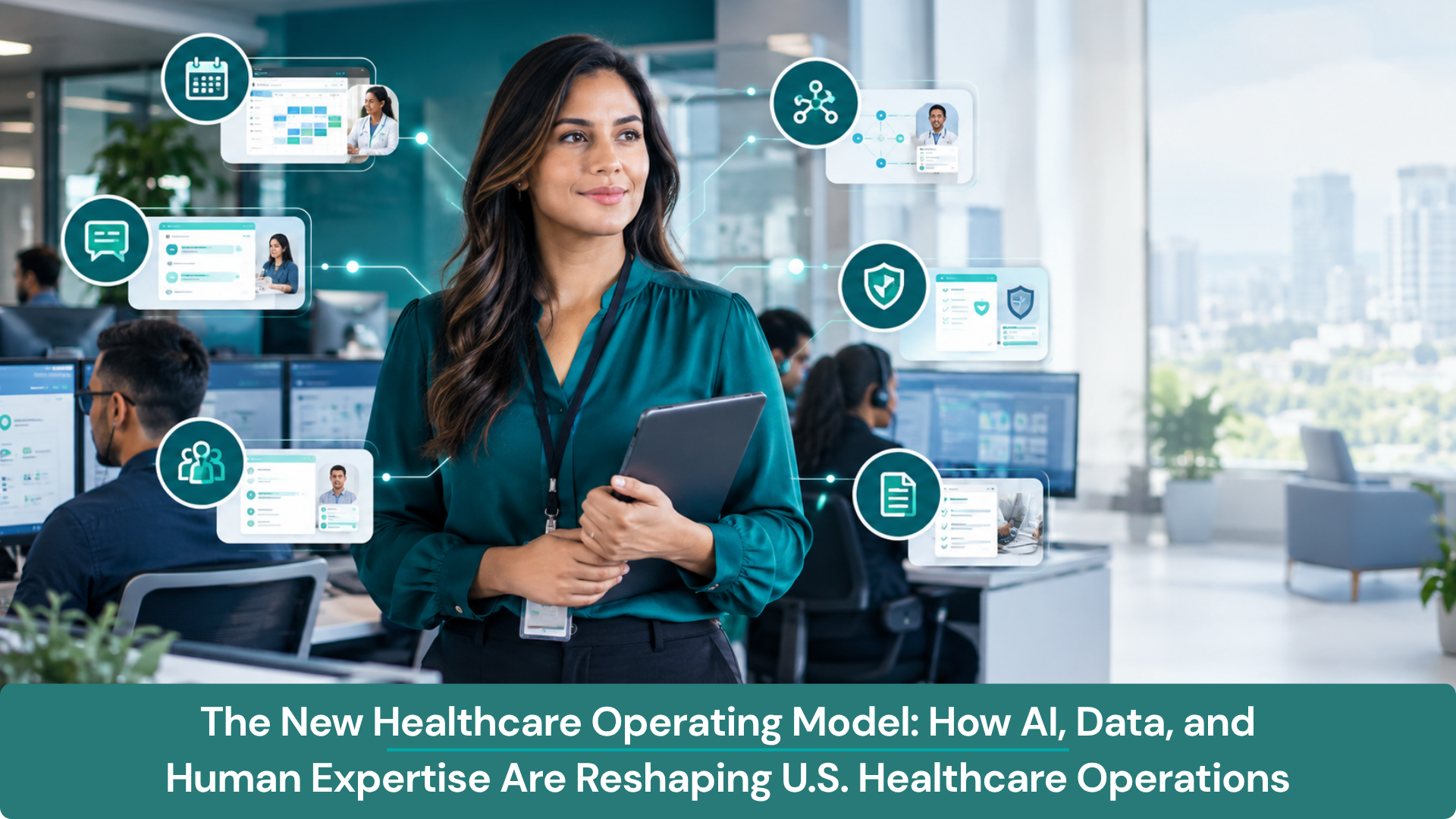
U.S. healthcare organizations are running an operating model built for a different era: more phone calls than any system can absorb, administrative workflows that depend on manual follow-up, and staffing models that assume the only way to do more is to hire more people. That model is under visible strain. At the same time, healthcare AI adoption has moved from pilot projects to production faster than almost anyone expected.
A healthcare operating model is the combination of workflows, technology, data, and staffing an organization uses to run patient access, scheduling, communication, and administrative operations day to day. The one most U.S. healthcare organizations still run was designed before AI, digital communication, and payer complexity reached today’s scale — which is why it’s straining under current volume.
The organizations pulling ahead aren’t choosing between AI and people. They’re building a model where artificial intelligence, connected data, and healthcare-trained human teams work together as a single system, rather than as competing solutions to the same problem. This article lays out what that model looks like, what the evidence says about where it works, and how healthcare executives should think about building it — including where nearshore healthcare operations fit into the picture.
Key Takeaways
- Administrative AI, not clinical AI, is scaling fastest in U.S. healthcare. Domain-specific AI adoption grew roughly sevenfold between 2024 and 2025, concentrated in scheduling, coding, billing, and prior authorization.
- AI is redesigning administrative work, not eliminating it. Research from MGMA and others describes a shift in tasks — from manual entry to oversight, exceptions, and judgment calls — rather than wholesale job elimination.
- The evidence supports a hybrid model, not full automation. Frameworks from Deloitte and independent healthcare analysts describe role-based division of labor between AI systems and human staff, with continuous human oversight built in.
- Administrative waste remains a massive, addressable cost. Industry-wide automation avoided an estimated $258 billion in U.S. healthcare administrative costs in 2024, with tens of billions more still recoverable from manual workflows.
- Nearshore healthcare BPO can extend this model at scale, combining healthcare-trained staff, U.S. time-zone alignment, and technology-enabled workflows to help organizations handle rising volume without proportional headcount growth.
Why the Traditional Healthcare Operating Model Is Breaking Down
Administrative complexity is consuming resources that should go to patient care
U.S. healthcare organizations run a large share of their operations through manual, disconnected processes: scheduling by phone, insurance verification by hand, prior authorization requests faxed or entered one at a time, and patient outreach through single-channel reminders. The CAQH Index estimates that automation and electronic transactions avoided $258 billion in administrative costs in 2024 — a 17% year-over-year increase — but roughly $21 billion in additional savings remains on the table in workflows that are still manual or only partially automated.
Physicians themselves feel this directly: research cited across industry sources puts physician time spent on administrative tasks — documentation, prior authorization, billing follow-up, inbox management — at up to 19 hours per week. That is time not spent with patients.
Patient expectations have moved past what manual processes can deliver
Patients now expect the same responsiveness from their healthcare provider that they get from any other service business: fast scheduling, two-way text and digital communication, and minimal friction. Missed appointments alone are estimated to cost the U.S. healthcare system roughly $150 billion annually, and research shows 60–65% of no-shows are preventable with better outreach and scheduling design. A single reminder text the night before an appointment, with no reschedule option and no follow-up if it’s ignored, no longer meets that bar.
Hiring more people isn’t a scalable answer
Healthcare organizations have historically responded to rising administrative volume by adding staff. That approach is increasingly constrained — by labor costs, by workforce shortages in administrative and clinical-support roles, and by the reality that headcount growth doesn’t scale linearly with patient volume or payer complexity. Executives need a way to absorb more volume without a proportional increase in fixed labor cost. That’s the gap AI and outsourcing are both being asked to fill — often separately, and often incompletely.
AI Is Moving Healthcare Beyond Simple Automation
From rules-based automation to intelligent workflows
Early healthcare automation was narrow: send a reminder, flag a missing field, auto-populate a form. The current wave — often called agentic AI, meaning AI systems that carry out multi-step workflows with limited human input at each step — goes further, drafting prior authorization requests, predicting no-show risk, or triaging patient messages end to end. Deloitte’s 2026 U.S. Health Care Outlook found that 61% of health system leaders are already building or implementing agentic AI, and 85% plan to increase investment over the next two to three years.
Where AI is creating the most measurable operational value
The evidence points to a consistent set of high-value use cases:
| Workflow | AI Impact (per available research) |
|---|---|
| Scheduling & no-show reduction | 30–50% reduction in no-shows reported across multiple studies |
| Revenue cycle / cost-to-collect | 30–60% reduction in cost-to-collect (McKinsey) |
| Medical coding | 45% adoption in large health systems in 2025, up from 22% in 2024 |
| Prior authorization | Among the top four front-office AI priorities per MGMA’s 2026 poll |
| Administrative cost avoidance | $258B avoided industry-wide in 2024 (CAQH Index) |
MGMA’s February 2026 survey of medical practice leaders found the top front-office AI priorities were scheduling (31%), patient calls and communication (27%), registration and eligibility (23%), and prior authorization (16%) — a clear signal that administrative operations, not clinical decision-making, is where AI adoption is concentrated.
Why AI alone isn’t enough
Despite the investment, Deloitte’s research found that 90% of surveyed leaders say fewer than 15% of their workflows have been materially transformed by AI agents, even though 45% report agentic AI already in production. That gap between pilot and impact is instructive. AI deployed onto a broken or disconnected workflow doesn’t fix the workflow — it just makes the existing process faster without fixing what was wrong with it. Prior authorization still requires clinical judgment on edge cases. Complex patient conversations still require empathy AI cannot reliably replicate. Exceptions, ambiguity, and escalation still land on a human being. The organizations getting real ROI are the ones that redesigned the workflow and the people model around AI — not the ones that layered AI on top of the old one.
The New Model: AI, Data, and Human Expertise as One System
Here’s the shift healthcare executives need to plan around: AI handles volume, connected data holds the workflow together, and healthcare-trained people handle everything that requires judgment. None of the three works well without the others.
The traditional model looked like this:
People → manual processes → disconnected systems
The model replacing it looks like this:
Connected data → intelligent workflows → automation → healthcare-trained human expertise → better patient and business outcomes
A useful way to think about this is as a division of labor across three layers, each doing what it does best:
AI and automation handle:
- High-volume, repetitive tasks (reminders, data entry, eligibility checks)
- Information retrieval (benefits verification, prior auth requirements)
- Data classification, routing, and prioritization
- Documentation assistance (ambient scribing, note drafting)
- First-pass scheduling and rescheduling logic
Healthcare-trained human teams handle:
- Exceptions and edge cases the system can’t resolve
- Complex patient interactions requiring empathy and judgment
- Escalations flagged by AI systems
- Payer-policy interpretation and appeal writing
- Quality control, audit, and workflows requiring clinical or coding knowledge
Executive leadership handles:
- Governance and named accountability for automated decisions
- Performance management and risk oversight
- Strategic prioritization of which workflows to transform first
A federal healthcare white paper from Critical Analytics (2026) formalizes this as a “hybrid human-AI workforce,” built on four principles worth adopting regardless of organization size: role-based division of labor, continuous human oversight with audit trails, bidirectional escalation (AI escalates ambiguity to humans; humans escalate repetitive load to AI), and shared memory and provenance — a single record of who or what took an action, when, and under what authority. This is also known as human-in-the-loop AI: automation that keeps a person positioned to intervene at defined points rather than running unsupervised. That last principle matters increasingly for HIPAA and compliance purposes as more decisions are AI-assisted.
Interoperability underpins all of it. None of this works without clean, standardized data moving across systems — which is why FHIR-based data exchange and EHR integration are described across the industry not as a technical nice-to-have, but as a prerequisite for AI to deliver value at all.
What This Looks Like Across the Patient Journey
Applied to a real patient journey, the model connects rather than isolates each function:
- Patient access & scheduling: AI predicts no-show risk and manages multi-channel outreach; a healthcare-trained team member handles the patient who calls back confused or needs a complex rescheduling accommodation.
- Referral & prior authorization coordination: AI drafts the request and gathers payer requirements; a trained team member reviews clinical nuance and manages the appeal if it’s denied.
- Patient communication: AI sends reminders and answers routine questions after hours; a human team member takes over when the conversation requires judgment, empathy, or de-escalation.
- Administrative and revenue cycle support: AI flags coding suggestions and claim errors; certified coders and billing specialists resolve denials and edge cases.
The point isn’t that each function gets a separate tool. It’s that AI and human effort are designed together, with clear handoff points, so patients experience one consistent operation rather than a patchwork of automated and manual touchpoints.
How Healthcare Leaders Should Evaluate an AI-Enabled Operating Model
Start with the workflow, not the technology. The organizations getting measurable ROI picked one or two high-friction, high-volume workflows — scheduling, prior authorization, revenue cycle — rather than spreading investment across many small pilots. McKinsey’s guidance to health system CEOs is direct on this point: fragmenting investment across a wide set of use cases dilutes impact.
Measure outcomes, not automation volume. Useful KPIs include:
- No-show rate and patient wait time
- First-pass claim approval rate and denial rate (industry benchmark: under 5%)
- Cost-to-collect and days-to-bill
- Admin hours recovered per week
- Patient satisfaction and abandonment rate on calls
Build governance in from the start. Every AI-assisted action affecting a patient or a claim should have a named human owner and an audit trail. As one industry commentator put it, an AI agent without a named accountable owner isn’t automation — it’s an unmanaged risk sitting at the point of care.
Build, Buy, or Partner? Choosing the Right Model
Most healthcare organizations face this decision workflow by workflow, not once at an enterprise level:
- Build internally when the workflow is a genuine competitive differentiator and you have the AI, security, and clinical operations talent to own it long-term.
- Buy a point solution when the workflow is a commodity problem — most scheduling and reminder automation falls here — and speed to value matters more than customization.
- Outsource or partner when the workflow is important but non-core, when internal capacity or specialized expertise (certified coders, healthcare-trained scheduling teams) is limited, or when 24/7 or surge coverage is needed without a proportional headcount increase.
- Hybrid — increasingly the most common real-world answer — combines AI-enabled technology with a healthcare-trained team that operates it, monitors exceptions, and maintains quality.
This is where nearshore healthcare operations fit into the model — not as a replacement for AI investment, but as the human execution layer that makes it work reliably at scale. Nearshore healthcare BPO refers to outsourcing patient access, scheduling, communication, or administrative work to healthcare-trained teams based in nearby countries (typically Latin America) that operate in U.S. time zones, rather than to distant offshore locations with limited overlap in working hours. Combined with technology-enabled workflows, this gives healthcare organizations a way to handle rising volume without expanding internal headcount proportionally, while maintaining the time-zone, language, and cultural alignment U.S. patients expect. Research across the sector points to nearshore models delivering 30–50% labor cost savings plus an additional 15–30% efficiency gain from standardized, automation-supported workflows — savings that can help fund the broader technology transformation rather than compete with it for budget.
Any outsourcing decision involving patient data requires the same rigor as an internal AI deployment: an executed Business Associate Agreement (BAA) before any PHI is shared, documented HIPAA safeguards (encryption, access controls, audit logging), and — critically — documented human review checkpoints in any AI-assisted workflow the partner runs. HIPAA does not prohibit offshore or nearshore handling of PHI; it requires that appropriate safeguards exist regardless of location, and executives should verify those safeguards directly rather than assume them.
Where This Is Headed
The health systems and medical groups pulling ahead over the next several years won’t necessarily be the ones with the most AI licenses. They’ll be the ones that redesigned their operating model — data, workflow, technology, and people — as one connected system, with clear rules for what AI handles, what people handle, and who’s accountable for the outcome.
The question in front of healthcare executives isn’t whether AI will change administrative operations. That’s already happening. The real question is whether an organization’s operating model — its data, its workflows, and its people — is designed to take advantage of it, or whether AI is simply being layered onto processes that were already breaking down.
Helium’s role in this model is specific: healthcare-trained teams, technology-enabled workflows, and nearshore scalability that let U.S. healthcare organizations extend their operating capacity without extending their operating risk.
Frequently Asked Questions
What is a healthcare operating model? A healthcare operating model is the combination of workflows, technology, data systems, and staffing an organization uses to run functions like patient access, scheduling, communication, and administrative operations. The “new” operating model described in this article combines AI-driven automation, connected data, and healthcare-trained human teams instead of relying on manual processes and headcount alone.
Is AI actually replacing administrative jobs in healthcare? The evidence is mixed but leans toward redesign rather than replacement. MGMA’s 2026 research describes AI as “slowly redesigning work in medical practices rather than replacing workers,” automating routine scheduling, documentation, and revenue cycle tasks so staff can focus on exceptions and patient-facing work. At the same time, roles built entirely around repetitive, rules-based tasks — like basic call-center customer service — face higher disruption risk than roles requiring judgment or healthcare knowledge.
What administrative tasks should a healthcare organization automate first? Start with high-volume, rules-based workflows with measurable outcomes: scheduling and reminders, eligibility verification, prior authorization drafting, and coding support. These are the areas where MGMA’s survey data and industry ROI evidence are strongest.
How much can AI actually reduce no-show rates? Reported reductions range widely, from roughly 20% with basic automated reminders to 40–50% with multi-channel, two-way communication and predictive outreach. The variation depends heavily on implementation quality — a single passive reminder text performs very differently from a system with predictive risk scoring and real-time rescheduling.
What’s the difference between nearshore and offshore healthcare outsourcing? Nearshore outsourcing places teams in nearby countries — commonly in Latin America for U.S. healthcare organizations — that share most or all of the U.S. working day, enabling real-time collaboration, live patient calls, and faster escalation to internal staff. Offshore outsourcing typically places teams in more distant time zones with limited working-hour overlap, which can slow real-time coordination for time-sensitive functions like scheduling and patient communication.
Is it safe, from a HIPAA standpoint, to outsource patient-facing administrative work to a nearshore team? Yes, provided the partner meets HIPAA’s requirements regardless of where the work is performed. That means an executed Business Associate Agreement before any PHI is shared, documented technical and administrative safeguards (encryption, access controls, audit logging, breach notification protocols), and — for AI-assisted workflows — documented human review checkpoints.
What’s the difference between automating a workflow and outsourcing it? Automation replaces repetitive manual steps with technology; outsourcing shifts execution of a workflow to a specialized external team. They aren’t competing options — most effective operating models combine both: AI handles the repetitive volume, and a trained team (internal or outsourced) manages exceptions, quality control, and complex patient interactions.
How should a healthcare executive measure ROI on an AI or outsourcing investment? Beyond direct cost savings, track recovered revenue, no-show reduction, days-to-bill, first-pass claim approval rate, denial rate, and admin hours reclaimed. A useful formula: ROI = (Recovered Revenue + Cost Savings − Implementation and Ongoing Cost) ÷ Implementation and Ongoing Cost. Avoid judging success purely by how much AI has been deployed — measure the operational outcome it produced.
What should we look for when evaluating a healthcare BPO or AI vendor partner? At minimum: verified HIPAA compliance (BAA, SOC 2 Type II or HITRUST, encryption standards), native integration with your EHR/PMS, documented AI-human escalation logic (not a sales deck description of it), healthcare-specific staff certifications, transparent performance data (denial rates, first-pass approval rates), and clear, outcome-based pricing.
Does moving to an AI-enabled operating model mean losing the human element of patient care? The evidence suggests the opposite is more common when the model is designed well. Clinicians in industry surveys consistently identify administrative automation as the AI application most likely to free up time for direct patient care — the goal is removing friction around the human interaction, not removing the human interaction itself.
Published on September 10, 2026